"The vendor documentation is the canonical source. The Discord is where it actually gets debugged. Plan accordingly."
Sage, Documentation-Pragmatist AI Agent
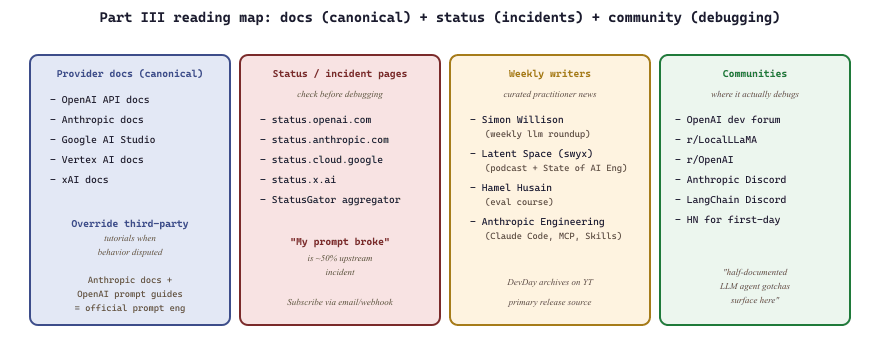
Part III's external resources split between provider documentation (canonical for API behavior, version-stable), and the community venues (Anthropic Discord, OpenAI forum, r/LocalLLaMA, LangChain Discord) where the half-documented LLM agent gotchas actually surface. This section is the curated map you keep open in a tab next to your API console.
Prerequisites
This is an end-of-part reading list and assumes familiarity with the Part III modules on APIs (Chapter 11), prompt engineering (Chapter 12), and hybrid ML+LLM patterns (Chapter 13). No new technical prerequisites.
Part III's external resources are split between provider documentation (which is canonical for API behavior), live status pages (which are canonical for what is breaking right now), and prompt-engineering literature.
14.5.1 Provider documentation
- OpenAI API docs: the source of truth for OpenAI behavior; check before believing any third-party tutorial.
- Anthropic docs: especially strong on tool use and prompt engineering best practices.
- Google AI Studio docs and Vertex AI docs: the two parallel surfaces for Gemini.
- xAI API docs: the Grok reference.
14.5.2 Prompt engineering guides
- Prompt Engineering Guide: the most comprehensive open guide, maintained by DAIR.AI.
- Anthropic's prompt engineering chapter: short, practical, and the closest to a vendor-endorsed "official" guide.
- OpenAI's prompt engineering guide: model-specific tips.
- DAIR.AI's GitHub repo: source for the guide above, with worked examples.
14.5.3 Status and incident pages
When your app fails at 2 AM, check the status page first; roughly half of "my prompt broke" incidents are upstream incidents.
14.5.4 Communities
- OpenAI developer forum.
- r/LocalLLaMA and r/OpenAI.
- Hacker News for first-day commentary on releases.
- Simon Willison's blog and weekly LLM roundups: the best single source for "what API engineers actually noticed this week"; his open-source
llmCLI is the right reference for command-line model calls. - Anthropic Engineering blog: separate from Research, focused on building with Claude (Claude Code, Computer Use, MCP, Skills).
- Hamel Husain's evals course material: the canonical 2024 practitioner content on building LLM-as-judge evals; the most-cited "your AI product needs evals" essay.
- Latent Space (swyx) and its annual State of AI Engineering report.
- OpenAI Devday session archive (every year since 2023) on YouTube: the primary source for new API features.
- Cursor docs, Claude Code docs, Aider docs: slash-command and AI-coding-tool documentation now reads as practical API-user reference, not just IDE help.
Subscribe to each provider's status page via email or webhook. The free tier of StatusGator aggregates them. Keep a local model-deprecation calendar (provider blog + status RSS) so you do not get surprised by a checkpoint EOL.
- Provider documentation is canonical for API behavior: OpenAI, Anthropic, Google AI Studio, Vertex AI, and xAI docs override any third-party tutorial when a request shape, header, or timeout is in dispute.
- Status pages catch upstream incidents quickly: roughly half of "my prompt broke at 2 AM" reports turn out to be provider-side, so OpenAI, Anthropic, Google Cloud, and xAI status feeds (or StatusGator aggregation) belong in the on-call alerting path.
- Prompt-engineering guides have a clear hierarchy: Anthropic's prompt-engineering chapter is the closest to a vendor-endorsed canon, OpenAI's guide carries model-specific tips, and DAIR.AI's Prompt Engineering Guide is the most comprehensive open companion.
- Communities surface gotchas before docs do: r/LocalLLaMA, OpenAI dev forum, Anthropic Discord, Hacker News, Simon Willison's weekly roundups, and the Anthropic Engineering blog are where half-documented agent failures get debugged.
- Hamel Husain's evals material is the canonical evals reference: the 2024 practitioner essays on building LLM-as-judge evaluation are the single most-cited "your AI product needs evals" reading for production teams.
- Maintain a model-deprecation calendar: provider blogs plus status RSS keep you ahead of checkpoint EOLs that would otherwise break production silently when a model is retired.
What's Next?
This chapter completes the current part. The next part, Part IV: LLM Training and Adaptation, opens a new arc; see the part index for chapter ordering.