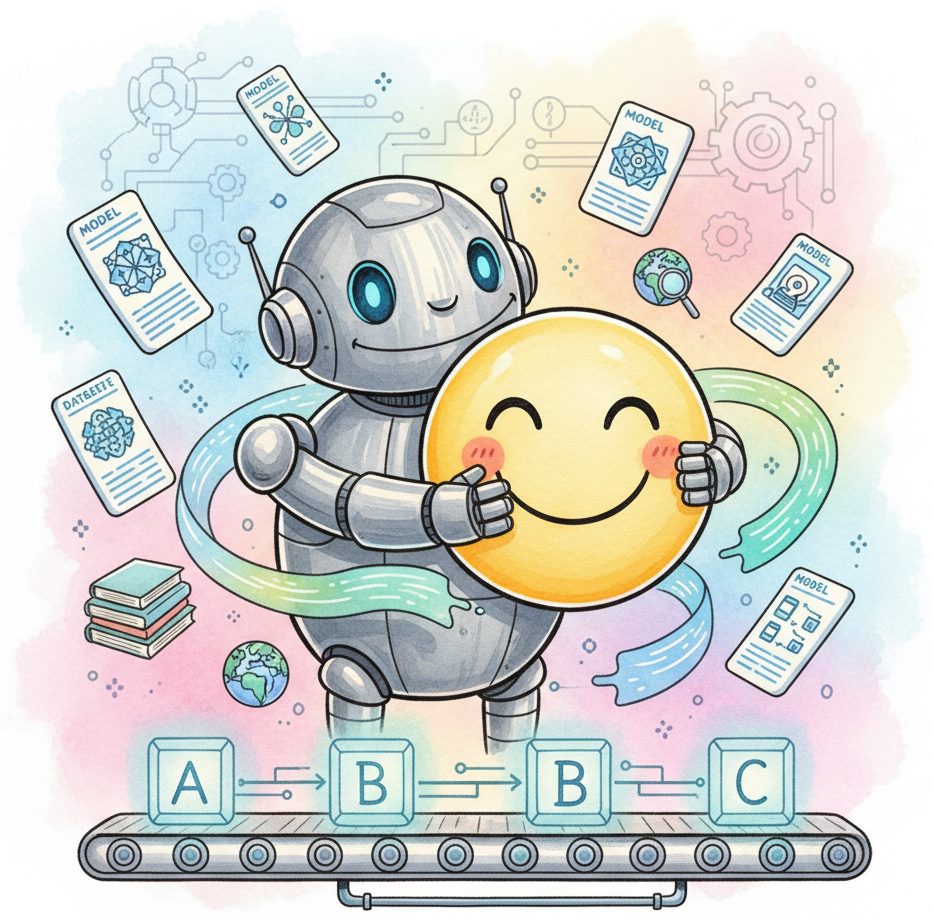
HuggingFace has become the central hub of the open-source LLM ecosystem, providing a tightly integrated suite of libraries that cover every stage of the model lifecycle. The transformers library alone offers access to over 400,000 pretrained models through a unified API, while companion libraries like datasets, tokenizers, peft, trl, and accelerate handle data preparation, parameter-efficient fine-tuning, alignment training, and distributed compute respectively.
Understanding HuggingFace tooling matters because it is the default interface for virtually every open-weight model released today. Whether you are loading a Llama 3 checkpoint for inference, fine-tuning Mistral with LoRA adapters, or running RLHF with DPO, the HuggingFace stack provides the canonical implementation. The Hub adds collaborative model sharing, dataset hosting, Spaces for demos, and integrated evaluation leaderboards.
This appendix is essential for ML engineers, researchers, and anyone working directly with open-weight models. If you plan to fine-tune, evaluate, or deploy models beyond closed API access, fluency with these libraries will save you significant development time.
This appendix builds directly on the transformer architecture covered in Chapter 4 and the fine-tuning workflows introduced in Chapter 14 and Chapter 15 (PEFT). For alignment and RLHF via TRL, see Chapter 17. Pretraining concepts that inform model loading and scaling are covered in Chapter 6.
Before diving into HuggingFace tooling, you should be comfortable with Chapter 4 (Transformer Architecture), which explains the model internals that these libraries wrap. You should also read Chapter 14 (Fine-Tuning Fundamentals) to understand the training concepts that the Trainer API and Accelerate automate. Familiarity with PyTorch tensors and basic Python packaging is assumed throughout.
Reach for this appendix when you need to load a pretrained model for inference or fine-tuning, prepare datasets with tokenization and streaming, apply LoRA or QLoRA adapters via PEFT, run DPO/PPO alignment with TRL, or distribute training across multiple GPUs with Accelerate. If you are using closed APIs exclusively (OpenAI, Anthropic, Google) and do not plan to work with open-weight models, you can defer this appendix. For orchestration frameworks that wrap LLM calls, see Appendix L (LangChain) or Appendix O (LlamaIndex) instead.