"Consensus among agents is like consensus among humans, except faster and with more JSON."
Census, Conflict-Resolving AI Agent
Multi-agent systems fail most often at the boundaries between agents, not within them. When Agent A hands off a task to Agent B, critical context can be lost, conflicting outputs can go unresolved, and sycophantic convergence can silently degrade quality. This section covers the two fundamental communication mechanisms (message passing and shared memory), consensus protocols for resolving disagreements between agents, and the failure modes that emerge when agents coordinate poorly. The A2A protocol from Section 23.3 formalizes many of these communication patterns at the protocol level.
Prerequisites
This section builds on tool use and protocols from Chapter 23 and agent foundations from Chapter 22.
1. Communication Patterns
Multi-agent systems require communication mechanisms that balance expressiveness with structure. The two fundamental approaches are message passing (agents send discrete messages to each other) and shared memory (agents read from and write to a common data store). Most production systems use a combination: message passing for task delegation and status updates, shared memory for data that multiple agents need to access.
In message passing systems, the format and semantics of messages matter enormously. Unstructured natural language messages work for prototype systems but become ambiguous at scale. Structured message formats with explicit fields for sender, recipient, message type (request, response, status update), content, and metadata provide the clarity needed for reliable multi-agent coordination. The A2A protocol formalizes this structure with its task and message primitives.
Shared memory systems use a common state store (often a dictionary, database, or key-value store) that all agents can read and update. LangGraph's TypedDict state is a form of shared memory: every node in the graph reads from and writes to the same state object. The advantage is simplicity. The risk is race conditions and conflicts when multiple agents try to update the same state simultaneously. LangGraph handles this through sequential node execution within a single graph step, but distributed multi-agent systems need explicit concurrency control.
The most common failure mode in multi-agent communication is context loss. When Agent A hands off a task to Agent B, critical context from Agent A's reasoning may not be included in the handoff message. Agent B then makes decisions without understanding why Agent A reached its conclusions. Always include relevant reasoning and intermediate results in inter-agent messages, not just the final output. Think of each handoff as an onboarding document for the receiving agent.
2. Consensus and Voting
When multiple agents produce different answers to the same question, the system needs a mechanism to resolve the disagreement. The simplest approach is majority voting: run the same agent N times (or run N different agents) and take the most common answer. This works well for tasks with clear correct answers (classification, factual questions) but breaks down for open-ended tasks where there is no single "right" answer.
More sophisticated consensus mechanisms include weighted voting (give more weight to agents that have been more reliable historically), debate-to-consensus (agents present arguments and iterate until they agree), and judge-based resolution (a separate agent evaluates each answer and selects the best one). The judge approach is the most common in production because it scales well and produces a clear audit trail: the judge explains why it selected one answer over others.
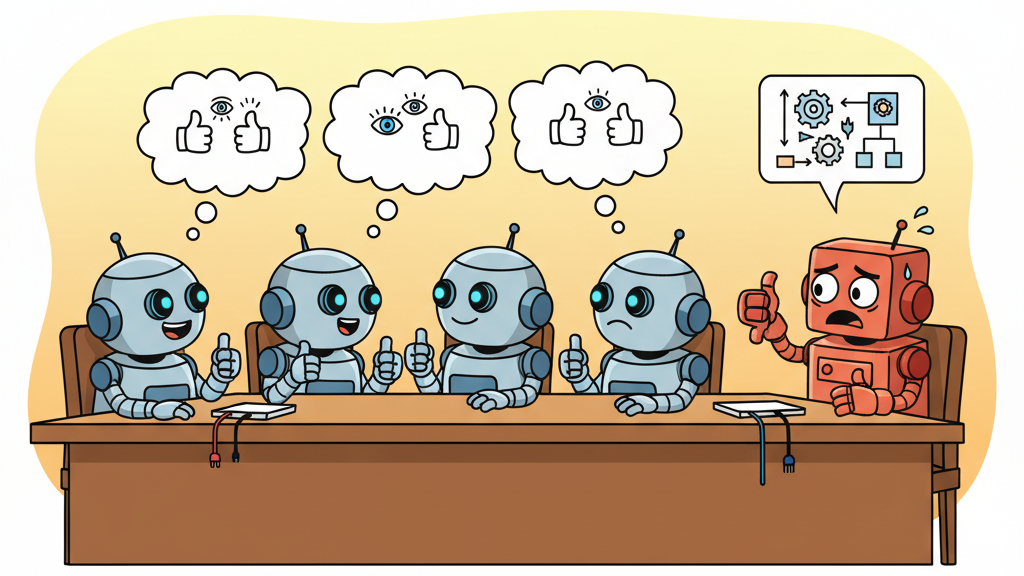
Research on multi-agent deliberation has revealed a persistent challenge: sycophantic convergence. When agents see each other's outputs, they tend to converge toward the majority position rather than maintaining diverse perspectives. ICLR 2025 research by Xiong et al. showed that this conformity effect is particularly strong when agents share the same base model. Mitigation strategies include: using different models for different agents, having agents reason independently before sharing outputs, assigning explicit "devil's advocate" roles, and structuring debate protocols that reward dissent.
Multi-agent debate does not guarantee better answers. In fact, for simple factual questions, debate can degrade performance because agents spend tokens arguing about things one agent already knows correctly. Use debate and consensus mechanisms for tasks that genuinely benefit from multiple perspectives: subjective evaluations, risk assessments, creative decisions, and analyses where different agents bring different knowledge or reasoning strategies.
The intuition behind sycophantic convergence is straightforward: LLMs are trained on human text, and humans tend to agree with confident statements. When Agent A sees Agent B's confident assertion, the model's training biases push it toward agreement rather than critical evaluation. This is the AI equivalent of groupthink in human teams. The antidote is the same in both cases: create structural incentives for dissent. Assign one agent the explicit role of finding flaws. Have agents reason independently before seeing each other's outputs. Use different base models so that shared training biases do not create artificial consensus. The goal is adversarial collaboration, not artificial harmony. The alignment techniques from Chapter 17 help explain why models exhibit this sycophantic tendency.
3. Conflict Resolution Strategies
Beyond disagreements in output, multi-agent systems face resource conflicts (two agents trying to use the same tool simultaneously), priority conflicts (urgent tasks competing with ongoing work), and scope conflicts (overlapping agent responsibilities). Each type requires a different resolution mechanism.
Resource conflicts are resolved through queuing and locking mechanisms borrowed from concurrent programming. If only one agent can access the database at a time, implement a mutex or rate-limited queue for database tool calls. Priority conflicts require a priority assignment system, where the supervisor or a dedicated scheduler determines which tasks take precedence. Scope conflicts are a design problem rather than a runtime problem: if two agents overlap in responsibility, clarify their boundaries in their system prompts and in the supervisor's routing logic.
Who: A portfolio analytics team at a wealth management firm building an AI stock analysis assistant for their advisors.
Situation: The team deployed a debate-pattern system where a Bull Agent (optimistic) and a Bear Agent (pessimistic) independently analyzed the same stock, giving advisors both perspectives. A Judge Agent then synthesized a final recommendation.
Problem: Early versions of the Judge Agent simply averaged the two recommendations, producing bland "hold" verdicts that advisors found useless. When the Bull Agent cited 23% YoY revenue growth and the Bear Agent cited a 40x P/E ratio and rising insider selling, the Judge had no way to weigh which evidence was more material.
Decision: The team rewrote the Judge Agent's prompt to evaluate evidence quality rather than conclusions. The Judge was instructed to classify each claim as data-supported (verifiable from financial APIs), model-based (derived from projections), or speculative (opinion without sourcing), then weight its synthesis accordingly.
Result: Advisor engagement with the tool rose from 22% to 68% after the change. The evidence-weighted Judge produced nuanced assessments like "Hold with caution: revenue growth is verified but valuation is historically stretched; monitor insider activity" that advisors described as "genuinely useful."
Lesson: When resolving conflicting agent outputs, instruct the judge to evaluate the quality of evidence behind each argument, not just the conclusions themselves.
Exercises
Describe three communication patterns for multi-agent systems (direct messaging, shared blackboard, broadcast) and give a scenario where each is most appropriate.
Answer Sketch
Direct messaging: one agent sends a request to a specific agent (e.g., supervisor to specialist). Shared blackboard: all agents read from and write to a shared state (e.g., collaborative document editing). Broadcast: one agent sends a message to all agents (e.g., announcing a deadline change). Direct is most efficient for known routing; blackboard for collaborative tasks; broadcast for system-wide updates.
Implement a majority voting mechanism where three LLM agents independently answer a question, and a function determines the consensus answer. Handle the case where all three answers differ.
Answer Sketch
Run three independent LLM calls with different temperatures or prompts. Compare answers using string similarity or semantic embedding distance. If two or more match (within a threshold), return the majority answer. If all three differ, either return the answer with highest confidence score, run additional agents to break the tie, or flag the disagreement for human review.
Two agents in a multi-agent system produce contradictory analyses of the same data. Describe three conflict resolution strategies and the trade-offs of each.
Answer Sketch
(1) Hierarchical: a designated authority agent decides. Fast but creates a single point of failure. (2) Evidence-based: each agent provides supporting evidence; the resolution favors the better-supported claim. More robust but slower. (3) Synthesis: a mediator agent finds common ground and produces a combined analysis. Most thorough but most expensive in terms of LLM calls.
Design a shared state object for a multi-agent document review system. The state must track the document, each agent's annotations, conflict markers, and the current review phase. Implement it as a Python TypedDict.
Answer Sketch
Define ReviewState(TypedDict) with fields: document: str, annotations: Dict[str, List[Annotation]] (keyed by agent_id), conflicts: List[Conflict] (pairs of contradictory annotations), phase: Literal['draft', 'review', 'resolution', 'final'], and resolved_document: Optional[str]. Each agent reads the full state and writes only its own annotations.
Describe three ways consensus mechanisms can fail in multi-agent systems and propose a mitigation for each.
Answer Sketch
(1) Groupthink: agents converge on the same wrong answer because they share similar biases. Mitigation: use diverse model providers or temperatures. (2) Deadlock: agents never reach agreement. Mitigation: set a maximum rounds limit and fall back to a designated tiebreaker. (3) Manipulation: one agent's output disproportionately influences others. Mitigation: use independent parallel generation before sharing, so each agent commits to an answer before seeing others.
- Communication patterns (direct, broadcast, pub-sub, blackboard) determine coupling and scalability of multi-agent systems.
- Conflict resolution strategies include voting, priority-based resolution, negotiation, and arbitration.
- The choice of communication pattern should match the coordination needs: tight coordination uses direct messaging, loose coupling uses pub-sub.
Show Answer
Direct messaging (point-to-point between two agents), broadcast (one agent sends to all), publish-subscribe (agents subscribe to topics), and shared blackboard (agents read and write to a common state). Each pattern has different coupling and scalability characteristics.
Show Answer
Common strategies include voting (majority wins), priority-based resolution (higher-authority agent wins), negotiation (agents argue with evidence until consensus), and arbitration (a dedicated resolver agent decides). The choice depends on whether correctness or speed matters more.
What Comes Next
In the next section, State Management, Workflows and Orchestration, we cover the engineering patterns for managing shared state, defining workflows, and orchestrating complex multi-agent pipelines.
References and Further Reading
Multi-Agent Communication
Demonstrates that structured debate between multiple agents with majority voting improves factual accuracy and reasoning, establishing the debate-and-vote consensus pattern.
Shows how structured multi-agent debate with diverse perspectives encourages divergent thinking and reduces convergence to incorrect answers.
Explores inception prompting for role-based agent communication, demonstrating how structured message passing enables cooperative task completion.
Consensus and Conflict Resolution
Studies how group dynamics and conflict resolution emerge in multi-agent systems, providing experimental evidence on consensus-building mechanisms.
Surveys communication strategies, voting mechanisms, and conflict resolution approaches across multi-agent frameworks, providing a comprehensive taxonomy.