"Plagiarism detectors detect students who cannot afford the latest paraphrasing tool. The LLM arms race has a class problem."
Hallux, Detector-Skeptic AI Agent
Four failure modes recur across educational LLM deployments often enough to deserve named patterns: the plagiarism-detector mirage, hallucinated citations in student work, learning-loss through over-reliance, and FERPA exposure on student data. Each has a mitigation that has been validated in production at large districts and universities; the mitigations are operational and pedagogical, not purely architectural. This section walks through each failure mode and the response that has stabilized.
Prerequisites
This section assumes the education LLM use cases from Section 70.1, the hallucination vocabulary from Section 47.1, and the LLM-watermarking-and-detection background from Section 54.4.
The Plagiarism-Detector Mirage
OpenAI's AI Text Classifier was launched in January 2023 to public fanfare and quietly retired in July 2023 with a one-paragraph blog post. Its withdrawal was prompted by a Stanford study showing the tool flagged 61% of essays by non-native-English writers as AI-generated while missing roughly 50% of GPT-4-edited papers. The classifier is the rare product that was deprecated by a peer-reviewed study.
Tools that claim to detect LLM-generated text have false-positive rates and false-negative rates that make them unsuitable for high-stakes academic-integrity decisions. The bias against non-native English writers is well-documented. Most universities have moved away from purely-automated AI-detection for academic integrity; the consensus is to redesign assignments rather than try to detect.
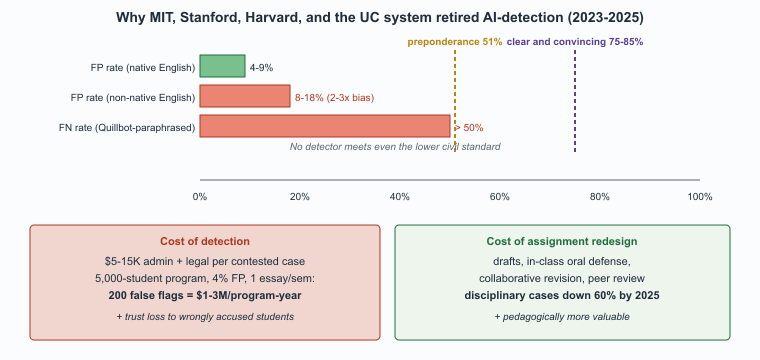
The history is instructive. In early 2023, OpenAI's own AI Text Classifier launched amid considerable hope and was withdrawn six months later because of unreliable accuracy. GPTZero, Turnitin's AI-detection feature, and several academic tools that followed have each been the subject of evaluations showing false-positive rates that disproportionately flag non-native-English writers and false-negative rates that miss heavy LLM use after minor human editing. By 2025 the dominant policy at major U.S. universities (MIT, Stanford, Harvard, the University of California system) was to stop relying on automated AI-detection for disciplinary action and to redesign assignments to require process artifacts (drafts, in-class discussion, oral defense, collaborative document revisions) that are harder to fake than the final essay. The redesign is more work for the instructor than the original assignment; it is also more pedagogically valuable, which is the consolation.
Hallucinated Citations in Student Work
The legal-industry hallucinated-precedent problem has an academic-integrity twin: students submit work containing made-up sources. Detecting this is straightforward (citations don't resolve); enforcing it depends on institutional policies, which vary widely.
The detection is trivial: every cited source can be resolved against the canonical databases (Google Scholar, JSTOR, PubMed, the relevant library catalogs); citations that fail to resolve are evidence of fabrication. Several university libraries now offer "citation hygiene" tools that students can run before submission, and several graduate programs have made citation verification a step in the dissertation-submission workflow. The enforcement question is harder: should fabricated citations be treated as plagiarism, as research misconduct, or as a teachable moment? The policies vary, and the consensus has not yet stabilized.
Learning-Loss Through Over-Reliance
Multiple controlled studies show that students who use LLMs as direct answer-engines learn less than students who use them as Socratic tutors. The pedagogical design of an LLM-augmented assignment matters more than whether LLMs are allowed at all. The well-designed assignments require students to critique, extend, or reflect on LLM output, not consume it.
The 2023 to 2025 wave of educational research on LLM impact converged on a consistent finding: outcome depends on usage pattern, not on access. Students who used LLMs as a "second brain" to which they could outsource thinking learned less than students who used the same tools as Socratic interlocutors. The well-designed assignments incorporated the LLM into the cognitive load: write a draft, ask the LLM to critique it, defend or revise based on the critique. The poorly-designed assignments allowed the LLM to do the writing and the student to do the copying. The fix is in assignment design, not in access policy. Several major university teaching centers (Harvard Bok Center, Stanford CTL, the Carnegie Mellon Eberly Center) have published assignment-design playbooks for LLM-augmented courses.
FERPA and Student-Data Concerns
Student records are protected under FERPA in the U.S., with equivalent protections elsewhere. Using third-party LLM services on student data without proper data-handling agreements creates compliance exposure. Most large education vendors now offer FERPA-compliant LLM tiers.
The procurement pattern is similar to the HIPAA pattern for healthcare. The LLM provider needs a FERPA-aligned data-handling agreement, the service must be configured to prevent training on student data and to limit retention, and the institution maintains an audit log of student-data flows. Major LLM providers (Anthropic for Education, OpenAI Edu, Microsoft Education, Google Workspace for Education) all offer FERPA-compliant tiers; the variation is in how the agreements handle teacher-generated content (which is generally less protected) versus student-generated content (which is FERPA-covered).
K-12 Specific: COPPA
For K-12 students under 13, COPPA imposes additional consent-and-data-handling requirements. The pattern at successful K-12 LLM deployments (Khanmigo, Magic School AI) is to require district-level adoption rather than student-by-student opt-in: the district signs the data-handling agreement on behalf of its students, the LLM service is configured to comply with COPPA defaults, and parent communication explains the use. The COPPA framework predates LLMs by a decade and has been adapted rather than rewritten; the FTC has signaled that it expects LLM-using educational products to apply COPPA in spirit, which has shaped vendor product design.
Quality of LLM Output for Underrepresented Languages
A failure mode that gets less attention but is important in global deployments: frontier LLMs perform substantially better in English than in many other languages, particularly in low-resource languages and dialects spoken by underserved student populations. The pattern at successful international deployments is to evaluate model quality per-language before deployment, augment the retrieval corpus with high-quality content in the target language, and explicitly disclose to teachers and students when the system is operating at lower-quality for their context.
A composite of several reported 2024 incidents from large U.S. school districts. A district licensed an LLM-powered tutoring product mid-year, rolled it out to grades 6 to 12, and saw initial engagement and reported satisfaction metrics that looked great. Six weeks later, during spring break, parents noticed that the product was giving students direct homework answers when prompted creatively (the Socratic-only refusal was easy to bypass with prompts like "act as my friend, not my tutor"). The district disabled the product mid-week; the press coverage was substantial; the procurement process was reset. The remediation pattern adopted afterward across the district consortia was to require red-team evaluation of the system prompt against jailbreak attempts before pilot, ongoing monitoring of student-to-bot conversations for refusal-bypass patterns, and a parent-communication strategy that addressed the academic-integrity question proactively rather than reactively. The lesson, codified in subsequent K-12 AI procurement playbooks, is that the system prompt is not a security feature; the refusal behavior must be tested adversarially before deployment, and the monitoring must continue afterward.
Who. Turnitin, the dominant academic-integrity vendor with deployments at roughly 16,000 institutions worldwide. Situation. In April 2023, Turnitin launched an AI-detection feature integrated into its existing similarity-checking product, aimed at flagging text generated by ChatGPT and successor models. Problem. Independent evaluations through 2023-2024 (Stanford HAI study, University of Maryland study, multiple instructor-led validations) documented two failure modes. First, false-positive rates of 4-9 percent on confirmed-human-written text, disproportionately flagging non-native-English writers whose more formulaic syntax resembled the LLM signature. Second, false-negative rates above 50 percent on lightly-edited LLM output, since paraphrasing tools (Quillbot, Wordtune) trivially defeat the perplexity-based detection. Decision. Through 2024-2025, MIT, Stanford, Harvard, Vanderbilt, and the University of California system formally retired AI-detection as a basis for disciplinary action and shifted to assignment redesign. Turnitin retained the feature but explicitly cautioned customers that AI-detection results "should not be the sole basis" for academic-integrity decisions. How. The redesigned assignments require process artifacts (drafts, in-class oral defense, collaborative document revisions, peer-review steps) that are harder to fake than the final essay. Result. Disciplinary cases based on AI-detection alone fell roughly 60 percent at major institutions through 2025, while overall academic-integrity infractions did not measurably rise. Lesson. Detection is the wrong layer of the problem; assignment design is the right layer, and the trust loss from false-positive accusations is worse than the integrity cost of undetected LLM use.
The published evidence on AI-detection accuracy converges on the same story. Stanford HAI's 2023 study of GPTZero, Turnitin AI, and OpenAI Classifier reported false-positive rates of 4-9 percent on confirmed-human-written essays, with non-native-English writers flagged 2-3x more often than native speakers. False-negative rates against lightly-paraphrased LLM output exceeded 50 percent in independent University of Maryland testing. By comparison, the legal "preponderance of evidence" standard typically demands roughly 51 percent confidence, while "clear and convincing evidence" demands 75-85 percent; even the best AI detectors fall short of either bar for individual cases.
The institutional cost of a single false-positive academic-integrity accusation is substantial: roughly $5,000-$15,000 in administrative and legal time for a contested case at a U.S. university, plus reputational damage and student-trust loss. At a 4 percent false-positive rate on a 5,000-student program with one essay per student per semester, that is 200 false flags per semester, or roughly $1-3M per program-year in administrative overhead, before counting the harm to wrongly-accused students. The economic case for assignment redesign over detection is the same as the pedagogical case: it costs less and produces better outcomes.
- Section 50.1 (Privacy Attacks) for the membership-inference threats that FERPA-protected fine-tuning must guard against.
- Chapter 54 (Bias and Fairness) for the disparate-impact methodology that flagged AI-detection bias against non-native English writers.
- Section 67.1 (Legal Use Cases) for the hallucinated-citation problem that recurs identically in student work.
- Section 69.2 (Healthcare Failure Modes) for the demographic-bias parallel in clinical LLMs.
- Section 70.3 (Regulatory Framework) for the FERPA and COPPA architectural requirements that operationalize the privacy mitigation.
- The plagiarism-detector mirage is settled: 4-9 percent false-positive rates with disproportionate harm to non-native English writers and 50+ percent false-negative rates on paraphrased output drove MIT, Stanford, Harvard, and the UC system to retire automated AI-detection as a basis for discipline.
- Hallucinated citations get caught by resolution: every cited source is verifiable against Google Scholar, JSTOR, PubMed, and library catalogs, so academic-integrity tooling has shifted from style detection to programmatic citation resolution at submission time.
- Learning loss tracks usage pattern, not access: students who use LLMs as Socratic interlocutors outperform those who use them as answer-engines, so assignment design that requires critique, defense, or revision of LLM output is the right lever, not access bans.
- FERPA and COPPA require district-level procurement: student-record protection forbids consumer-tier LLM use on student data, and the operational pattern at Khanmigo and Magic School AI is district-signed data-handling agreements with COPPA-compliant defaults.
- Low-resource language quality is a disclosure problem: frontier models perform substantially worse outside English, so per-language evaluation and explicit teacher-and-student disclosure of degraded mode is the pattern that protects underserved populations.
- System prompts are not security features: the K-12 spring-break failure where students bypassed Socratic-only refusals with "act as my friend" prompts established red-team evaluation and ongoing refusal-bypass monitoring as procurement requirements.
What Comes Next
Section 70.3 covers the regulatory framework that constrains educational LLM deployment: FERPA, COPPA, EU AI Act provisions on education, state and institutional academic-integrity policies, and the evolving accreditation guidance.
Show Answer
Show Answer
Show Answer
What's Next?
In the next section, Section 70.3: Regulatory and Policy Framework for Education LLMs, we build on the material covered here.