"FERPA, COPPA, EU AI Act, accreditation. The four regulatory rails that decide which LLM tutor your school can actually license."
Compass, Education-Compliance-Reader AI Agent
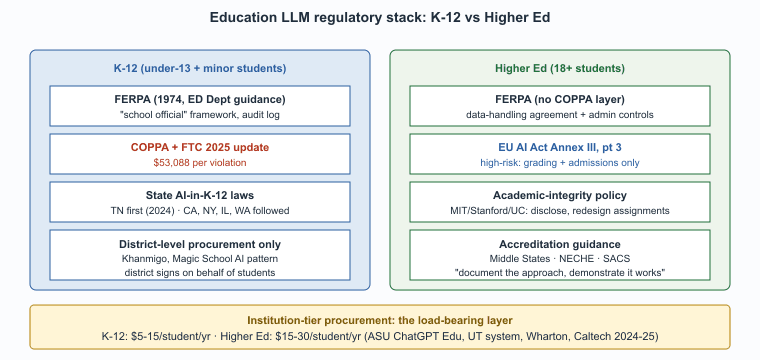
Five regulatory and policy tracks shape educational LLM deployments in 2026: student-privacy laws (FERPA, COPPA, and state equivalents), the EU AI Act's high-risk classification for education systems, state and institutional academic-integrity policies, accreditation considerations, and the emerging patchwork of state-specific AI-in-education laws. Each track imposes specific obligations; together they shape both procurement and assignment design. This section maps each to the patterns that satisfy it.
Prerequisites
This section assumes the education LLM failure modes from Section 70.2 and the LLM-policy vocabulary from Section 53.1.
FERPA and Student-Privacy
FERPA was passed in 1974 partly in response to a single Senate hearing where a parent complained that a college had refused to release her son's grades to her. The resulting law is so broad that its definition of "education record" arguably covers chatbot transcripts, an interpretation that the U.S. Department of Education's 2024 AI-vendor guidance more or less confirmed without saying so explicitly.
FERPA (the Family Educational Rights and Privacy Act, 1974) governs student records at any U.S. educational institution receiving federal funding. All LLM tools that process student records require contractual protections. Many districts and universities maintain approved-vendor lists; vendors that cannot demonstrate FERPA-aligned data handling are eliminated early in procurement. The U.S. Department of Education's Student Privacy Policy Office publishes FAQs and guidance documents that practitioners track closely; the 2024 guidance on AI vendors clarified that LLM providers processing student data are "school officials with legitimate educational interest" under FERPA only if they meet specific contractual and operational requirements.
COPPA and Child Online Protection
COPPA (U.S.) and child-online-protection rules elsewhere restrict data collection on under-13 users; affects K-12 LLM deployments. The FTC issued an updated COPPA Rule in 2025 that specifically addressed generative AI: parental consent must be specific, must address AI use, and must specify what training and retention apply. Vendors selling into K-12 must either obtain district-level consent (the dominant pattern) or implement student-by-student consent mechanisms compatible with COPPA's verifiable-parental-consent requirements. The latter is operationally complex; the former is standard.
EU AI Act Provisions on Education
AI systems used to determine access to education or evaluate learning outcomes are high-risk under the EU AI Act Annex III, point 3. Conformity assessment required. The classification specifically catches automated grading systems, admissions-decision systems, and adaptive-testing systems where the AI materially influences the outcome. Educational chatbots and tutoring systems that do not make consequential decisions are generally not high-risk under the Act, but the boundary is contested for products that produce predictive analytics on student outcomes.
State and Institutional Policies on Academic Integrity
Highly variable; the trend is away from blanket bans and toward assignment-redesign. By 2025 most major U.S. universities had moved from "AI is banned" policies to "AI use is governed by the assignment and disclosed by the student" policies. The variation across institutions is meaningful: some require explicit citation of LLM use (akin to citing a research assistant), others require disclosure only above a use threshold, others delegate the policy to individual instructors. Multi-campus systems must support per-campus policy configuration.
Accreditation Considerations
Higher-ed accreditation bodies are issuing guidance on AI use in teaching, learning, and assessment. The Middle States Commission on Higher Education, the New England Commission of Higher Education, and the Southern Association of Colleges and Schools have all issued AI-related guidance through 2024 to 2025. The substance is converging on three principles: (1) institutions must have a documented AI policy, (2) assessment validity must be maintained in the face of AI access, and (3) faculty must be supported in understanding and adapting to AI tools. The accreditation bodies have not issued rigid rules; they expect institutions to document their approach and demonstrate it works.
The State-Specific Patchwork
U.S. state laws on AI in education have proliferated. Tennessee was the first state with an AI-in-K-12 statute (2024); California, New York, Illinois, and Washington have followed with varied scopes. The common theme is procurement transparency: districts must disclose AI tools in use, parental notification requirements apply for some use cases, and bias testing is required for high-impact uses. Multinational and multi-state vendors must support per-jurisdiction configuration; centralizing the platform without centralizing the policy layer creates compliance debt.
The most consequential policy decision in an educational LLM deployment is not about AI specifically; it is about assignment design. Whatever the regulatory framework allows, the question is whether the assessments produce a valid signal of student learning given that LLMs exist and students can use them. Institutions that have rebuilt assessment around process artifacts (drafts, in-class oral defense, collaborative editing, structured peer review) report that the AI-detection problem largely disappears: the AI cannot fake the process, only the artifact. Institutions that have not rebuilt assessment report that the AI-detection problem is unsolvable. The regulatory framework permits both approaches; the pedagogical effectiveness of one is markedly higher.
Who. Arizona State University, the largest public research university in the U.S. by enrollment (roughly 145,000 students), the founding ChatGPT Edu customer announced January 2024. Situation. ASU sought an enterprise-tier LLM platform with FERPA-aligned terms, SSO integration, admin-configurable guardrails, and per-department instructional support. Problem. The off-the-shelf ChatGPT consumer product was incompatible with FERPA on student records, and the per-instructor procurement of LLM tools created policy fragmentation, integration burden, and academic-integrity inconsistency across colleges. Decision. ASU signed a system-wide ChatGPT Edu agreement covering all students and faculty, paired with a Center for Learning Innovation that produces course-design playbooks and provides per-college pedagogical support. How. The data-handling terms specify no training on inputs, configurable retention, and FERPA-aligned audit logs; admin controls let department chairs configure tool availability and usage policies for their courses; the Center for Learning Innovation publishes assignment templates that build LLM-engagement into the assessment design. Result. By mid-2025, ASU reported usage by >80 percent of active students and faculty across at least one academic-year semester, with documented integration into more than 200 specific courses. The University of Texas system, Wharton, Caltech, and roughly 15 other large universities signed analogous agreements through 2025. Lesson. The institution-tier procurement (data-handling terms, admin controls, pedagogical support) is the load-bearing layer; the underlying model is interchangeable, and the value flows to the institutions that invest in faculty support and assignment redesign rather than to those that simply unlock the tool.
The numbers shaping educational-LLM procurement compliance are stark. FERPA penalty exposure: the formal sanction for a FERPA violation is withdrawal of federal funding, but in practice the Department of Education's Family Policy Compliance Office (FPCO) issues findings and remediation orders; the cost of a finding is typically $500K-$2M in administrative remediation, plus reputational harm. COPPA penalty exposure: the FTC's 2025 COPPA Rule update authorizes penalties of up to $53,088 per violation, and FTC enforcement actions against EdTech vendors (most recently the Edmodo case and the WW International case) have produced settlements in the $1.5-5M range plus mandated 20-year compliance monitoring.
Vendor procurement cost: FERPA-aligned data-handling agreements with major LLM providers (Anthropic for Education, OpenAI Edu, Microsoft Education, Google Workspace for Education) are typically priced at $5-15/student/year for K-12 and $15-30/student/year for higher education, with the higher tier reflecting additional administrative controls and SSO integration. For a 100,000-student state university system, the all-in FERPA-tier cost is roughly $1.5-3M/year, comparable to the cost of a single regional learning-management system seat license. State patchwork overhead: California, New York, Illinois, Washington, and Colorado together require ~0.5 FTE of in-house counsel time per year to maintain per-jurisdiction policy configurations for a vendor operating in all of them. The compliance cost is real but small relative to the value of the institution-tier deployment.
- Section 53.4 (Licensing, IP, Privacy) for the BAA and data-handling-agreement structure that operationalizes FERPA.
- Chapter 53 (Regulation and Compliance) for the broader compliance methodology used across regulated verticals.
- Section 69.3 (Healthcare Regulatory Framework) for the parallel structure (FDA + HIPAA + EU AI Act + state patchwork) in the healthcare vertical.
- Section 72.3 (Government Regulatory Framework) for the OMB M-24-10 and Section 508 parallels in public-sector LLM deployment.
- Chapter 50 (Privacy and Data Protection) for the broader privacy architecture underlying FERPA and COPPA compliance.
Show Answer
Show Answer
Show Answer
What's Next?
Section 70.4: Pedagogically-Scaffolded Tutor Architecture covers the architecture that has consolidated as the dominant pattern across the major educational LLM products.