"Blue-team LLM use cases: alert triage, phishing review, code-review-for-vulns. The boring SOC work that an LLM actually moves the needle on."
Sentinel, SOC-Triage-Native AI Agent
Cybersecurity is the LLM vertical where the analyst-hour shortage is most acute, the cost of a missed alert compounds the fastest, and the failure mode of auto-executing an LLM recommendation showed up as a series of well-documented production incidents in 2024. The reference deployments by mid-2026 form a recognizable shortlist: Microsoft Security Copilot wired to Defender XDR and Sentinel has become the de-facto enterprise SOC copilot, vendor-side competitors like SOC.ai and CrowdStrike Charlotte AI own significant pieces of the analyst-augmentation market, and Google's Sec-PaLM lineage continues to underpin Mandiant's threat-intel synthesis. The framework integration is now routine: every credible SOC copilot maps findings to MITRE ATT&CK tactics and techniques, and reasoning chains cite ATT&CK identifiers so analysts can pivot directly into the canonical adversary-behavior taxonomy. Six categories of blue-team work have reached production: SOC alert triage and enrichment, phishing email analysis, code review for vulnerabilities, incident postmortem drafting, threat-intelligence synthesis, and detection-as-code generation. The takeaway: the deployments that survive contact with enterprise security teams sit at a strict generator-verifier posture where the LLM accelerates investigation and the credentialed analyst retains decision authority. The major commercial vendors (Microsoft Security Copilot, CrowdStrike Charlotte AI, Splunk AI Assistant) all default to recommend-only after the auto-execute incidents of 2024; a handful of SOAR vendors still ship auto-isolation and auto-blocking playbooks (Tines, Torq, Palo Alto Cortex XSOAR), but these are gated on signature-based rather than LLM-generated triggers in defensible deployments.
Prerequisites
This section assumes familiarity with the agent-safety framing from Chapter 49 and the broader safety/security framework from Chapter 47. The OWASP Top 10 for LLM Applications and MITRE ATLAS are covered later in this chapter.
SOC Alert Triage and Enrichment
Microsoft Security Copilot's name was almost "Defender Copilot" until a late 2023 branding review noticed that the broader copilot product family did not need every name to start with "Defender". The Charlotte AI name at CrowdStrike was reportedly chosen because the CrowdStrike threat-intel team had been informally naming threat clusters after cities, and Charlotte was where George Kurtz lived during the company's founding.
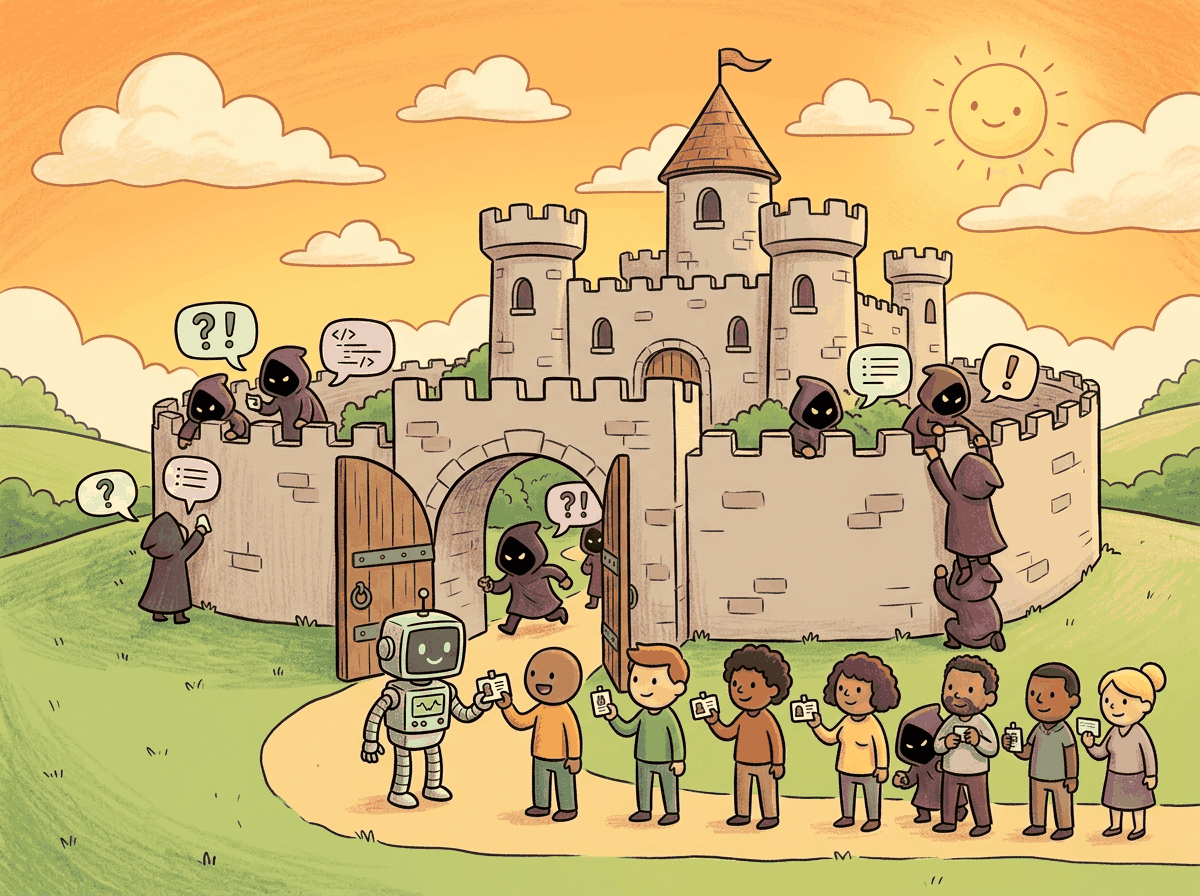
The clearest production win. Security Operations Center analysts drown in alert volume; LLMs that read the alert, pull related context (asset CMDB, recent activity, threat intel, similar past incidents), and produce a structured triage recommendation cut analyst time per alert by a meaningful fraction. Vendor-published numbers cluster in the 50-70% range (Microsoft Security Copilot, CrowdStrike Charlotte AI), with most independent SOC reports landing at the lower end of that range and higher productivity reserved for routine, high-volume alert categories where the LLM can leverage a corpus of similar past tickets; novel incidents and advanced persistent threats see smaller gains. Vendors: Microsoft Security Copilot, CrowdStrike Charlotte AI, Tines, Torq, Tracecat. The pattern is generator-verifier: LLM proposes, analyst confirms or overrides, every decision audit-logged.
At 02:17 local time, an EDR alert fires: anomalous PowerShell on a finance-department laptop, command-line obfuscation, outbound connection to a previously-unseen domain. Without LLM augmentation, the on-call tier-1 analyst would spend 20-40 minutes context-switching between the EDR console, the SIEM, the threat-intel platform, and the CMDB. With Microsoft Security Copilot wired to Defender XDR, or CrowdStrike Charlotte AI wired to Falcon, the analyst asks one natural-language question ("summarize this incident and what we know about the user, the host, and the network destination"). The agent pulls the originating alert, the previous 48 hours of logs from the host, the user's role and recent activity, threat-intel reputation for the destination, and a list of similar past incidents. It returns a structured triage memo: severity rating, suggested next steps, recommended containment actions, and a confidence score. The analyst confirms one action (isolate host), rejects another (do not auto-disable the user account, the request is routine for the finance role), and signs off. Every prompt, retrieval, recommendation, and decision is logged for after-action review. Reported time savings from CrowdStrike's published metrics: roughly 40 analyst-hours saved per week per team and 70% reduction in manual investigation effort.
Phishing-Email Analysis
LLMs analyze suspected phishing emails, extract IOCs (URLs, sender domains, file hashes), check them against threat intel, summarize the attack pattern. Reduces the time-to-block on novel phishing campaigns from hours to minutes. Abnormal Security and Proofpoint have built variants of this into their cloud-email-security gateways; the LLM is one component of a larger detection stack, not a standalone product. Early reports suggest the false-positive-rate reduction can be meaningful, but unlike the SOC-triage figures above this claim lacks independent benchmarks, so treat it as directional: by reading the email semantics rather than relying on signature-based matching alone, the LLM catches social-engineering attempts that older heuristics miss.
Code Review for Security Vulnerabilities
LLMs trained or prompted to identify common vulnerability patterns (SQL injection, XSS, path traversal, hardcoded secrets, insecure deserialization, race conditions) catch real issues in real codebases. Don't replace SAST tools; do reduce false-positive review time and catch patterns SAST misses. Used in pre-commit hooks and PR review. Snyk, GitHub Advanced Security, and several open-source frameworks (Semgrep with LLM augmentation, CodeQL-LLM integration) all ship LLM-augmented code review in 2026. The pattern: LLM flags potential issues with explanations, the developer evaluates and accepts or rejects, the decision is logged. The LLM is a peer reviewer, not a gate.
Incident Postmortem Drafting
Given a timeline of events from the SIEM, an LLM drafts the executive summary, the technical timeline, and the action-item list. The IR lead reviews and refines. Major productivity win. Several major IR teams report that the LLM-drafted postmortem reaches "executive-ready" state in 30 to 60 minutes rather than the half-day or full-day previously required.
Threat Intelligence Synthesis
Daily/weekly digests of relevant threat-intel feeds, blog posts, and CVE announcements, filtered for relevance to the organization's stack. Replaces several analyst-hours per week per coverage area. The pattern matches the legal-industry citation-verification posture: every claim in the digest must cite its source, and the digest links to the original article rather than paraphrasing without attribution.
Detection-as-Code Generation
"Write me a Sigma rule for detecting [behavior X]." LLMs produce credible first-draft detection rules that an analyst then tunes and tests. Reduces detection-engineering bottleneck. The same pattern works for Splunk SPL, Elastic KQL, and the various cloud-native detection languages (AWS GuardDuty rules, Azure Sentinel analytic rules). Every rule is reviewed and tested in staging before production; no auto-deploy of LLM-drafted detections.
Vulnerability-Management Triage
Beyond the six above, a seventh emerging category: LLMs that map newly-published CVEs to the organization's internal asset inventory, draft prioritization narratives, and pre-populate ticket text. Wiz, Snyk, and Tenable have all built variants. The LLM does not autonomously patch; it produces the analyst-readable summary that accelerates the human-in-the-loop prioritization.
Every successful blue-team LLM deployment in 2026 sits at the same human-in-the-loop posture: the LLM accelerates the analyst's decision, the analyst remains responsible for the decision. The 2024 attempts to auto-execute LLM recommendations (auto-isolate hosts, auto-disable accounts, auto-block destinations) produced the false-positive-storm incidents that Section 71.3 covers. The industry has consolidated firmly on generator-verifier patterns where the LLM accelerates investigation but the decision authority remains with a credentialed human. The cycle-time win is large; the safety win is preserved.
The SOC-LLM productivity case is anchored in published numbers from the major platforms. Alert volume: a typical mid-market enterprise SOC handles 10,000-50,000 alerts per day, with roughly 5-15 percent surviving initial automated filtering for human triage. Time per alert (pre-LLM): tier-1 triage averages 20-40 minutes per alert with context-switching across EDR, SIEM, threat intel, and CMDB consoles. Time per alert (with LLM augmentation): Microsoft Security Copilot and CrowdStrike Charlotte AI both report 50-70 percent reductions in alert-investigation time. CrowdStrike's published metrics claim roughly 40 analyst-hours saved per week per team.
ROI calculation. A 10-person SOC with $130K average fully-loaded cost ($1.3M/year payroll) saving 40 hours/week is recovering roughly 2,000 analyst-hours/year worth of capacity. At $65/hour effective rate, that is ~$130K/year of recovered analyst time per team. Microsoft Security Copilot is priced at roughly $4 per security compute unit (SCU) with consumption tied to query volume; a typical mid-market SOC consumes ~10,000-30,000 SCUs per month, putting the platform cost at $480K-$1.4M/year. The ROI is positive on time recovery alone for larger SOCs; the deeper case (caught threats that would otherwise be missed, faster mean-time-to-respond) drives adoption.
The cost of an unaugmented SOC failing to keep pace is harder to quantify but well-documented in 2024-2026 breach reports: average dwell time (the period between initial compromise and detection) in 2023 was 277 days globally (IBM Cost of a Data Breach 2023), with the cost of breaches detected in <100 days roughly $1M lower per incident than those detected in >200 days. Mandiant's M-Trends reports a much shorter median dwell time, because the two metrics measure different things. The LLM-augmented SOC's value proposition is structural: at modern alert volumes, the unaugmented team cannot keep up.
- Chapter 47 (Adversarial Security and Red Team) for the broader red-team and threat-modeling framework that this chapter's blue-team applications complement.
- Chapter 49 (Agent Safety and Autonomy) for the agent-architecture safety framework that constrains auto-execute deployments.
- Section 30.2 (Agent Frameworks) for the LangGraph, CrewAI, AutoGen, and OpenAI Agents SDK runtimes that underpin SOC-LLM agents.
- Section 44.3 (Observability) for the audit-logging and trace-analysis stack that supports SOC-LLM forensics.
- Chapter 32 (RAG) for the retrieval pattern over threat-intel feeds and historical incidents.
Show Answer
Show Answer
Show Answer
What Comes Next
Section 71.2 turns to offensive (red-team) use cases. The defenders need to understand attacker capabilities to defend against them, but the section is calibrated to public information rather than extending what attackers can already do.
What's Next?
In the next section, Section 71.2: Offensive (Red Team) Use Cases, we build on the material covered here.