"C2PA is what happens when you ask metadata to be load-bearing. The metadata mostly holds, until someone uploads to Twitter."
Pixel, Manifest-Pessimist AI Agent
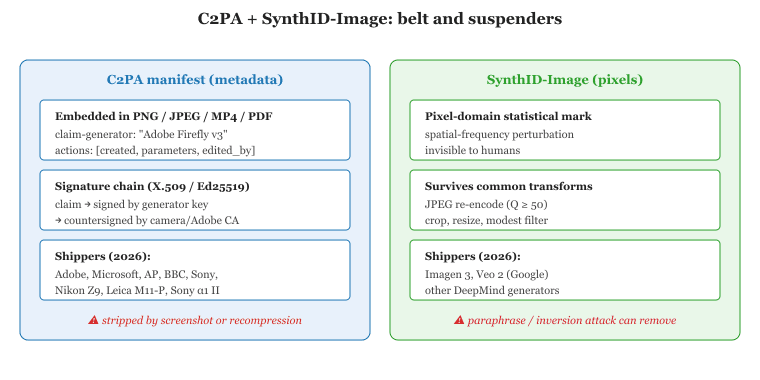
Image and video provenance is further along than text in real-world deployment. Two complementary technologies have hardened into shipping standards: C2PA (Coalition for Content Provenance and Authenticity), a cryptographic content-credentials manifest that piggybacks on existing image metadata; and SynthID-Image, a pixel-domain statistical watermark from Google DeepMind that survives common transformations (JPEG re-encoding, cropping, modest filtering). Adobe Content Credentials, Microsoft, the AP, the BBC, Sony, Nikon, and Leica have all shipped C2PA-conformant pipelines as of 2026. This section walks through the C2PA 2.x specification (manifest structure, signature chains, claim generators), SynthID-Image's design, and the integration pattern that combines both layers.
Prerequisites
This section assumes the image-generation pipelines from Section 19.7, the video-generation models from Section 20.7, and the provenance framing from Section 54.1.
54.3.1 C2PA: Cryptographic Provenance as Metadata
The C2PA standard signs metadata cryptographically, which means a single screenshot strips every cryptographic guarantee out of an image. Adobe and Microsoft both ship C2PA support and both also ship screenshot tools. The two facts have not yet been reconciled at the product level.
The Coalition for Content Provenance and Authenticity (C2PA) was founded in 2021 by Adobe, the BBC, Intel, Microsoft, Sony, Truepic, and others to define an open standard for content credentials. The standard reached version 2.0 in 2024 and 2.1 in 2025, with stable conformance test suites and a growing list of certified implementers. The design is pragmatic: rather than invent a new file format, C2PA defines a manifest structure that embeds inside existing containers (PNG, JPEG, MP4, GIF, MP3, PDF) via standard metadata blocks.
A C2PA manifest contains:
- Assertions: structured claims about the asset (who created it, when, with what tool, what transformations were applied). Standard assertion types include
c2pa.actions(an ordered list of operations like "captured", "edited", "exported"),c2pa.hash.data(the cryptographic hash of the pixel/audio data binding the manifest to the file), andc2pa.thumbnail. - Claim generator: the software or hardware that wrote the manifest (e.g., "Adobe Photoshop 26.0", "Sony Alpha 1 II firmware 3.0"). This is signed by the manufacturer's key chain.
- Signature: a cryptographic signature over the assertions, produced with a private key whose public key is anchored to a trust list (the C2PA Trust List is run by the Joint Development Foundation).
- Parent linkage: a content-addressable hash of the input asset. When an edit produces a new asset, the new manifest references the old asset's hash, building a chain of custody.
54.3.2 Anatomy of a C2PA Manifest
{
  "claim_generator": "Adobe Photoshop 26.0 (c2patool/0.10.0)",
  "claim_generator_info": [
    {"name": "Adobe Photoshop", "version": "26.0",
     "icon": {"format": "image/svg+xml", "identifier": "icon.svg"}}
  ],
  "title": "campaign-photo-final.jpg",
  "format": "image/jpeg",
  "instance_id": "xmp:iid:7b1d24bb-92c4-4f8f-9a7d-fc1a2b3c4d5e",
  "thumbnail": {
    "format": "image/jpeg",
    "identifier": "thumbnail.jpg"
  },
  "ingredients": [
    {
      "title": "raw-DSC0042.NEF",
      "format": "image/x-sony-raw",
      "instance_id": "xmp:iid:1a2b3c4d-5e6f-7890-abcd-ef1234567890",
      "relationship": "parentOf",
      "hash": "sha256-9f86d081884c7d659a2feaa0c55ad015..."
    }
  ],
  "assertions": [
    {
      "label": "c2pa.actions.v2",
      "data": {
        "actions": [
          {"action": "c2pa.created", "when": "2026-02-14T09:30:00Z",
           "softwareAgent": "Sony Alpha 1 II 3.0", "digitalSourceType":
           "https://cv.iptc.org/newscodes/digitalsourcetype/digitalCapture"},
          {"action": "c2pa.edited", "when": "2026-02-14T11:45:00Z",
           "softwareAgent": "Adobe Photoshop 26.0",
           "parameters": {"description": "color grading, crop"}}
        ]
      }
    },
    {
      "label": "stds.iptc.photo-metadata",
      "data": {"dc:creator": ["Jane Doe / Reuters"]}
    }
  ],
  "signature_info": {
    "alg": "ps256",
    "issuer": "Adobe Inc.",
    "cert_serial_number": "abc123def456",
    "time": "2026-02-14T11:45:30Z"
  }
}ingredients array links back to the raw camera file's hash, forming the parent edge in the provenance graph. The actions.v2 assertion records the create-edit chain with timestamps and software agents. The signature is produced with the publisher's private key; verifiers check it against the certificate chain anchored to the C2PA Trust List.C2PA does not say "this image is real." It says "this image has not been altered since signature time T by signer S." A camera with a secure-mode firmware signs at capture; an editor's signature chains to that capture. If any byte after the signing point is changed without re-signing, validation fails. But the manifest cannot speak to what was in front of the camera. Provenance and truth are different problems and only the former is what C2PA solves.
A C2PA-signed asset chain is mathematically a Merkle-style provenance graph. Let $a_0$ be the raw capture, $a_1, \ldots, a_n$ its edited descendants, and $M_i$ the manifest for $a_i$. Each manifest contains the pixel hash $h_i = \mathrm{SHA256}(\mathrm{pixels}(a_i))$, the parent edge $\mathrm{parent\_hash}_i = h_{i-1}$, and a cryptographic signature
Verification walks the chain from $M_n$ back to $M_0$: confirm $\sigma_i$ with the certificate-list public key $pk_i$, then check $\mathrm{parent\_hash}_i \stackrel{?}{=} h_{i-1}$ against the previous manifest's recorded pixel hash. Tampering anywhere breaks at least one equality. C2PA 2.x uses PS256 (RSASSA-PSS with SHA-256) as the default signature alg; for camera-to-edge trust paths, HMAC-SHA256 with a TEE-resident key bridges to public-key chains.
Algorithm: C2PA-VERIFY-CHAIN
Input:  Asset bytes A_n, manifest chain (M_n, M_{n-1}, ..., M_0),
        trust list TL of accepted certificate authorities
Output: verdict in {VALID, INVALID, UNTRUSTED}, signer chain

  // 1. Pixel-hash binding for the leaf
  h_n_computed = SHA256( pixels(A_n) )
  If h_n_computed != M_n.assertions["c2pa.hash.data"]:
    Return INVALID                          // post-signature tamper

  // 2. Walk the chain from leaf to root
  For i = n downto 1:
    // Recover and validate signature
    cert_i = M_i.signature_info.cert
    If cert_i not in chain rooted at TL:
      Return UNTRUSTED                      // unknown signer
    If Verify( M_i, sigma_i, cert_i.public_key ) is false:
      Return INVALID                        // manifest tampered

    // Parent-edge integrity
    parent_h_recorded = M_i.ingredients[0].hash
    parent_h_actual   = M_{i-1}.assertions["c2pa.hash.data"]
    If parent_h_recorded != parent_h_actual:
      Return INVALID                        // broken provenance edge

    // Optional timestamp monotonicity
    If M_i.signature_info.time < M_{i-1}.signature_info.time:
      Return INVALID                        // backdated signing

  Return (VALID, [ M_i.signature_info.issuer for i = 0..n ])
The chain is functionally equivalent to a Git commit history with cryptographic signatures: each manifest commits to (its content + its parent's pixel hash), so the only way to alter a leaf without detection is to forge every signature back to the root. Production verifiers cache trust-list lookups, but the per-asset verification cost is microseconds on commodity hardware (C2PA Specification v2.1, 2025).
54.3.3 The c2patool Pipeline in Practice
Adobe's open-source c2patool CLI and its underlying c2pa-rs Rust library are the reference implementation. A minimal sign-and-verify flow:
import subprocess, json
from pathlib import Path

def sign_image(input_path: Path, manifest: dict, output_path: Path,
               cert_path: Path, key_path: Path) -> None:
    """Sign an image with a C2PA manifest using c2patool."""
    manifest_path = output_path.with_suffix(".manifest.json")
    manifest_path.write_text(json.dumps(manifest))
    subprocess.run([
        "c2patool", str(input_path),
        "--manifest", str(manifest_path),
        "--sign_cert", str(cert_path),
        "--sign_key", str(key_path),
        "--output", str(output_path),
    ], check=True)

def verify_image(path: Path) -> dict:
    """Validate the manifest. Raises if the signature is invalid."""
    result = subprocess.run(
        ["c2patool", str(path), "--detailed"],
        capture_output=True, text=True, check=True,
    )
    report = json.loads(result.stdout)
    return {
        "validated": report["validation_status"] == "valid",
        "signer": report["active_manifest"]["signature_info"]["issuer"],
        "claim_generator": report["active_manifest"]["claim_generator"],
        "ingredients": report["active_manifest"].get("ingredients", []),
    }

# Usage in a publishing pipeline:
verdict = verify_image(Path("incoming/photo.jpg"))
if not verdict["validated"]:
raise RuntimeError("manifest invalid; reject or flag for review")54.3.4 SynthID-Image: Pixel-Domain Watermarking
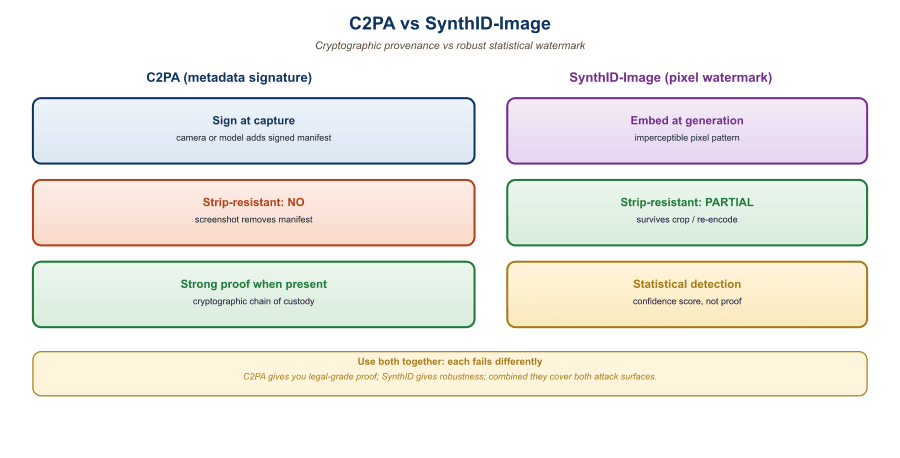
C2PA's weakness is that its manifest is stored in metadata, and metadata gets stripped. A screenshot, a re-upload through a platform that strips XMP, or a malicious actor's exiftool -all= all destroy the manifest while preserving the pixels. This is where pixel-domain watermarking complements C2PA. SynthID-Image, deployed by Google for Imagen and Veo outputs, embeds a watermark directly into the pixels via a learned encoder, designed to survive:
- JPEG re-encoding at quality 60 and above
- Cropping to 50% of the original area
- Mild Gaussian blur and sharpening
- Screenshot (display-and-recapture) at typical phone-camera resolutions
- Color-balance shifts within the range produced by photo-editor sliders
SynthID-Image trains an encoder and a detector jointly, in the style of an adversarial autoencoder. The encoder adds a small, spatially-distributed perturbation to the generated image; the detector must recover the embedded bit pattern. During training a differentiable augmentation layer applies the very transforms attackers use, JPEG re-encoding, cropping, blur, resampling, between encoder and detector, so gradients push the watermark into pixel statistics that survive those operations. A perceptual loss simultaneously penalizes visible changes, so the optimum is a perturbation invisible to humans but legible to the detector. Detection is a fast forward pass that outputs a calibrated probability, with the false-positive rate bounded by held-out evaluation on natural images.
The watermark is detected by a small neural network that runs in milliseconds on a CPU. False-positive rate on natural (non-AI) images is bounded by design at <0.1% via held-out evaluation.
54.3.5 The Publisher Workflow: Camera to CDN
A modern publisher workflow that produces verifiable images end-to-end:
- Capture. A C2PA-aware camera (Sony Alpha 1 II, Nikon Z9 with the 2024 firmware update, or a phone running a certified C2PA app) signs at the moment of capture. The hardware secure element holds the private key; the public certificate is anchored to the manufacturer's trust list.
- Edit. Adobe Photoshop, Lightroom, and Premiere all preserve and amend the manifest. Each edit appends a new action to
c2pa.actions.v2with a timestamp and parameters; the resulting file is re-signed by the editor's certificate. - Publish. The CMS serves the image with the manifest intact and exposes the verification UI to readers (Content-Credentials.org displays the chain in a popover).
- Downstream. Social platforms that respect C2PA (Meta and TikTok announced support in 2024) extract the manifest, display "Made with AI" or "Verified by [signer]" labels, and propagate the credentials to embeds.
The biggest open weakness in C2PA deployment is that many social and messaging platforms still strip metadata aggressively, often as a side effect of image-resizing for bandwidth. Meta announced C2PA preservation in 2024 but follow-up audits in 2025 showed inconsistent behavior. Until manifest-stripping becomes user-visible (the way HTTPS deprecation in browsers became visible to users), publishers cannot rely on consumer-side validation alone. Pixel-domain watermarks like SynthID-Image are the partial answer, but they identify only the generator, not the editor or the publisher.
54.3.6 Video Provenance: Temporal Claims
Video provenance extends the C2PA model to include temporal claims: which frames were synthesized, which edits affect which segments, what voice-cloning was used for which speakers. The C2PA 2.1 specification adds the c2pa.segments assertion for this purpose.
In practice, video provenance is harder because: (a) video files are large enough that re-signing on every edit is expensive; (b) frame-level edits multiply the assertion count; (c) common platforms transcode videos aggressively (YouTube re-encodes everything), making byte-exact hashing brittle. The 2025 working-group output recommends segment-hash trees: each segment is hashed independently, the root hash is signed, and verifiers can check individual segments without re-hashing the whole file.
An EU-based image-generation startup, complying with AI Act Article 50, ships every output with both layers: (1) SynthID-Image embedded in the pixels via the model's decoder; (2) a C2PA manifest in the JPEG metadata identifying the model version, the generation parameters, and a SHA-256 hash of the prompt. Users can verify either layer independently. Survival expectations: C2PA manifest is intact until the file passes through a metadata-stripping intermediary, at which point SynthID becomes the fallback. The detection API runs at ~10ms per image on CPU, costing fractions of a cent. The combined system meets the regulatory bar at engineering cost of approximately one engineer-month per quarter for maintenance.
Image and video provenance ships in production via two complementary technologies. C2PA gives strong cryptographic provenance through a manifest chain anchored to a trust list, supported by Adobe, Microsoft, Sony, Nikon, the AP, and the BBC. SynthID-Image embeds a pixel-domain watermark that survives metadata loss and common transformations. Production publishers use both: C2PA when the manifest is intact, SynthID as the fallback when metadata is stripped. EU AI Act Article 50 makes this stack a compliance requirement, not an option, for generative image and video APIs serving the EU market.
Show Answer
Show Answer
Show Answer
Show Answer
Continue to Section 54.4: Deepfake and Synthetic-Media Detection.
Section 54.4 covers detection: when provenance is absent (no manifest, no watermark), how do classifiers tell synthetic from natural imagery? We will look at GAN-vs-diffusion fingerprint analysis, video temporal artifact detection, and the ensemble methods that achieved >95% accuracy on the 2025 Deepfake Detection Challenge.