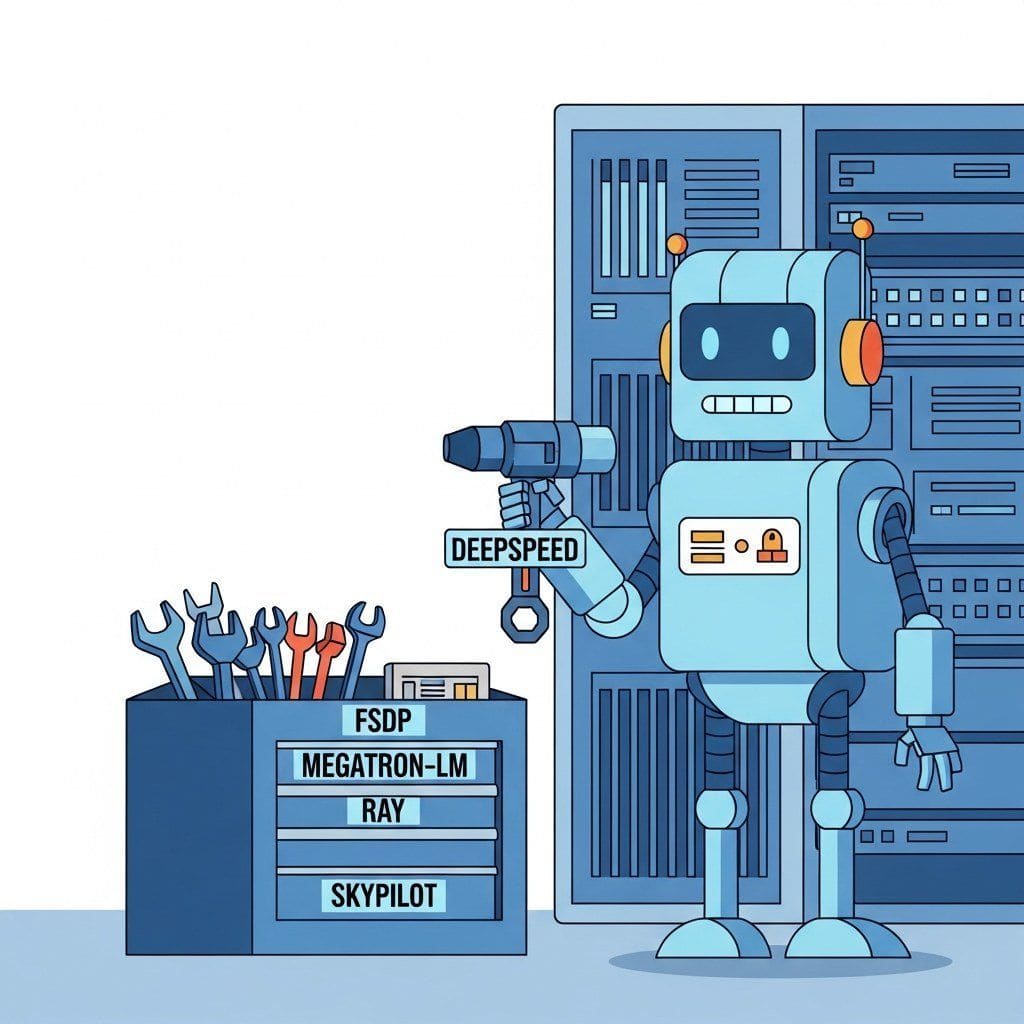
"Choose tools whose bill of materials you can explain to your CFO."
Scale, Stack-Building AI Agent
Chapters 57 through 60 built the systems story. This chapter inventories the tools that operate them: NeMo, Megatron, DeepSpeed, FSDP, JAX, vLLM, TensorRT-LLM, llama.cpp, and the orchestration glue (Slurm, Kubernetes) that keeps a large cluster productive.
The systems-at-scale ecosystem includes orchestration platforms (Slurm, Ray, Kubeflow), distributed training frameworks (Megatron, DeepSpeed, FSDP, Colossal-AI), profiling tools (Nsight, PyTorch Profiler), and the cluster-management surface. This chapter is the practical reference.
Chapter Overview
Part XII covered compute planning, frontier hardware, distributed training, and edge deployment. This chapter consolidates the scale toolchain: hyperscaler clouds (AWS SageMaker HyperPod, GCP Vertex / TPU, Azure ML, OCI), specialized GPU clouds (CoreWeave, Lambda, RunPod, Modal, Together, Fly.io, Cloudflare AI), HPC schedulers (Slurm, Volcano), the distributed-training libraries (Megatron-LM, DeepSpeed, PyTorch FSDP2, Colossal-AI, Accelerate), the high-level recipes (torchtitan, Levanter, Axolotl, LLaMA-Factory, TRL), the pretraining corpora (FineWeb, RedPajama-v2, The Pile, C4, The Stack v2), the open-weight bases and MoE checkpoints, and the systems venues (SC, ISC, MLSys, OSDI, SOSP, NSDI) that anchor the literature.
- Choose between hyperscaler clouds and specialized GPU clouds for a given workload and budget.
- Configure HPC schedulers (Slurm, Volcano) for a multi-node training run.
- Compare distributed-training libraries (Megatron-LM, DeepSpeed, PyTorch FSDP2, Colossal-AI) for a target model.
- Apply high-level recipes (torchtitan, Levanter, Axolotl, LLaMA-Factory, TRL) to a production training pipeline.
- Select pretraining and alignment corpora across FineWeb, RedPajama-v2, The Stack v2, UltraFeedback, and OASST.
- Track the systems venues and engineering blogs that maintain the scale canon.
Sections in This Chapter
Prerequisites
- Distributed training from Chapter 59
- Inference optimization from Chapter 9
- Comfort with at least one container or workload-manager system
- 61.1 Platforms Hyperscaler clouds (AWS SageMaker HyperPod, GCP Vertex / TPU, Azure ML, OCI), specialized GPU clouds (CoreWeave, Lambda, RunPod, Modal, Together, Fly.io, Cloudflare AI), HPC schedulers (Slurm, Volcano, KubeRay, Kubeflow, Argo), parallel storage (Lustre, GPFS, Weka, BeeGFS, FSx), and training observability (W&B, MLflow, Comet, Aim).
- 61.2 Libraries and Frameworks Distributed training foundations (Megatron-LM, DeepSpeed, PyTorch FSDP2, Colossal-AI, Accelerate), high-level recipes (torchtitan, Levanter, Axolotl, LLaMA-Factory, TRL), optimization kernels (FlashAttention 2/3, xformers, bitsandbytes, Transformer Engine), communication (NCCL, NVSHMEM, MSCCL), orchestration (Ray Train, SkyPilot, Composer, Flyte), and compilers (torch.compile, Triton, TensorRT-LLM).
- 61.3 Datasets and Benchmarks Pretraining corpora (FineWeb, FineWeb-Edu, RedPajama-v2, The Pile, C4 / mC4, CulturaX, The Stack v2), instruction and alignment data (UltraFeedback, OASST, FLAN, OpenHermes, SmolTalk), multimodal corpora (LAION-5B, DataComp, OBELICS), training-system benchmarks (MLPerf Training, NCCL Tests), evaluation harnesses (lm-eval-harness, HELM), and compute profilers.
- 61.4 Models Open-weight dense bases (Llama-3.1 / 3.2 / 4, Mistral Large 2, Qwen2.5 / 3, Yi-Large, Falcon, DBRX, Gemma), MoE checkpoints (DeepSeek-V3 / R1, Mixtral 8x22B, Snowflake Arctic, Llama-4 Scout / Maverick, Grok), long-context models (Gemini 2.5, Claude 4.5, Yi-1.5 200K), distillation-target small models (Llama-3.2 1B / 3B, Phi-3.5, Gemma-2 2B, SmolLM2), and the proprietary frontier.
- 61.5 External Reading and Communities Systems venues (SC, ISC, MLSys, OSDI, SOSP, NSDI), the 20-paper canon (Megatron-LM, DeepSpeed ZeRO, FlashAttention, GShard, Pathways, Llama-3 herd, DeepSeek-V3, OPT-175B logbook, BLOOM), engineering blogs (Hugging Face, PyTorch, DeepSpeed, Yi Tay, Interconnects), communities (r/LocalLLaMA, EleutherAI Discord, MLCommons), newsletters, and a weekly reading cadence.
What's Next?
This chapter begins with Section 61.1: Platforms. Each section builds on the previous one, so we recommend reading them in order.