"Standards are wonderful. That is why every vendor invents their own."
Pip, Protocol-Weary AI Agent
MCP is USB for AI: a universal protocol that lets any agent connect to any data source or tool. Before MCP, every tool integration required custom code for each LLM provider and each external service. MCP standardizes this into a single client-server protocol with capability negotiation, structured message formats, and multiple transport layers. With over 6,400 community-built servers and adoption by Claude Desktop, Cursor, and many open-source frameworks, MCP has become the de facto standard for agent-to-tool connectivity. This section covers the protocol architecture, server development in Python and TypeScript, and practical patterns for building production MCP integrations.
Prerequisites
This section builds on agent foundations from Chapter 26 and LLM API basics from Chapter 11.
27.2.1 What Is MCP?
Anthropic open-sourced the Model Context Protocol in November 2024 with the modest framing of "an open standard for connecting AI assistants to data sources." Within ten weeks Cursor, Continue, Sourcegraph, and three rival labs had MCP servers in production, and "USB-C for LLMs" became the canonical analogy. The protocol is one of the rare cases in modern AI where a vendor proposed a standard, the community shrugged, then six months later realized they had been quietly speaking it the whole time.
Anthropic Connectors are first-party managed integrations (Google Drive, Slack, GitHub, Confluence) that Claude can query directly without a custom MCP server, trading customization for operational simplicity. Claude Plugins are the curated marketplace tier on top of MCP: third-party developers publish capabilities into the Claude platform, similar to ChatGPT Plugins (now GPT Actions) or Google Agentspace Marketplace Extensions. The pedagogical point: MCP is the open protocol; Connectors and Plugins are the provider's curated, hosted distribution layer on top. Pick based on how much customization vs. operational burden you can absorb.
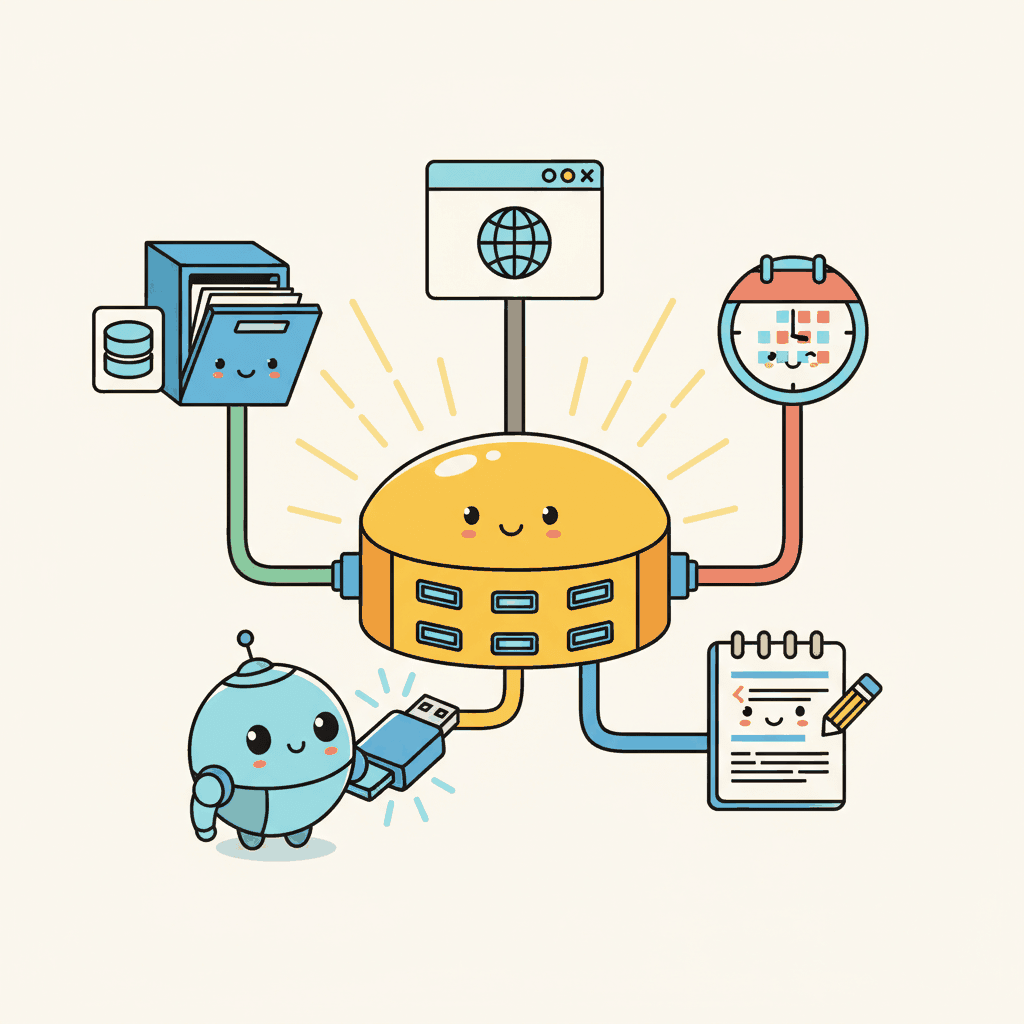
The Model Context Protocol (MCP) is an open standard created by Anthropic that defines how LLM applications connect to external data sources and tools. Think of it as USB for AI: a universal interface that lets any MCP-compatible application connect to any MCP server without custom integration code. Before MCP, every tool integration required bespoke code for each LLM provider and each data source. MCP standardizes this into a single protocol with well-defined message formats, capability negotiation, and transport layers.
The adoption has been rapid. As of early 2026, the MCP ecosystem includes over 6,400 community-built servers covering databases, APIs, file systems, development tools, and cloud services. The TypeScript and Python SDKs see over 97 million monthly downloads combined. Major AI applications including Claude Desktop, Cursor, Windsurf, and numerous open-source AI agent support MCP natively. This ecosystem effect means that building one MCP server makes your tool available to every MCP-compatible agent, rather than requiring separate integrations for each platform.
MCP follows a client-server architecture. The MCP host is the LLM application (Claude Desktop, your custom agent). The MCP client is a protocol handler within the host that manages connections. MCP servers expose tools, resources (data), and prompts through the protocol. A single host can connect to multiple servers simultaneously, giving the agent access to a rich set of capabilities through a unified interface.
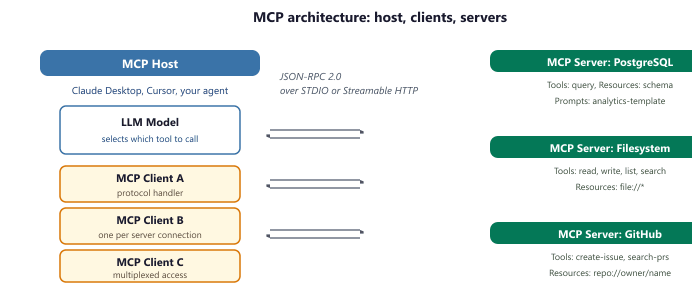
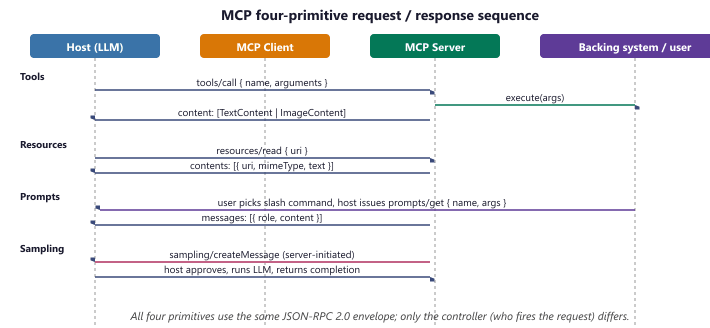
MCP's power lies in its four primitives: Tools (executable functions the model can call), Resources (data the application can read), Prompts (reusable prompt templates), and Sampling (a server-initiated request for an LLM completion sent back through the client). Most developers start with Tools, but Resources are equally important for agents that need to read configuration files, database schemas, or documentation without making the model "call" a function. Resources let the host application pull context proactively rather than waiting for the model to request it. Sampling is the fourth, less-used but distinctive primitive: it inverts the normal direction of the protocol so that a server (for example, a code-generation MCP server in the middle of an agentic flow) can ask the host's LLM to review or expand an intermediate artifact without the server needing to host its own model.
The four primitives are not just different shapes of payload; they differ in who decides when each fires. This controller taxonomy is the single most useful mental model for designing an MCP server, because it tells you which surface to expose for which capability.
| Primitive | Controller | Trigger | Example |
|---|---|---|---|
| Tools | Model-controlled | The LLM emits a tools/call in its tool-call slot. | The model decides it needs the current weather and calls get_weather. |
| Resources | Application-controlled | The host reads the resource and injects it into context before the model runs. | The IDE reads file://README.md as part of the system prompt at session start. |
| Prompts | User-controlled | The host exposes the prompt template in its UI (slash command, palette) and the user picks it. | A user types /code-review in Claude Desktop to invoke a prompt template. |
| Sampling | Server-initiated | The server sends a sampling/createMessage request back through the client; the host approves and forwards to its LLM. | A code-gen server asks the host's LLM to review an intermediate diff during a multi-step flow. |
The controller is not arbitrary: it is what protects the user. A user-controlled Prompt cannot run without an explicit click; an application-controlled Resource is bounded by the host's allowlist; a model-controlled Tool can have side effects but must round-trip through the host; a server-initiated Sampling request is always mediated by the host so the server never sees the model directly.
Any MCP tool with real-world side effects (sending email, creating a Jira ticket, running an SQL UPDATE, merging a pull request) requires user approval mediated by the host. The protocol pattern is: the server returns a tool-call result that describes the proposed action; the host surfaces a confirmation dialog with the action and its arguments; the server only executes after the host forwards the user's approval. This is the same pattern Claude Desktop uses to ask "this server wants to write to your filesystem, allow once / always / no", and it is why the canonical GitHub MCP server in the example above deliberately omits merge_pull_request: the cost of getting approval wrong is higher than the value of skipping the human in the loop. Side-effect approval should be designed into the tool schema (an explicit dry_run mode that returns the planned action without executing), not bolted on by the host.
MCP's design follows a principle from software engineering with deep roots in systems theory: the separation of interface from implementation, formalized as the "dependency inversion principle" by Robert C. Martin and, more broadly, as the concept of "loose coupling" in systems design. In economics, this principle is known as standardization: just as the shipping container (introduced by Malcolm McLean in 1956) revolutionized global trade by creating a standard interface between ships, trucks, and trains, MCP creates a standard interface between AI agents and tools. Before MCP, every agent framework implemented its own tool-calling protocol, creating an N x M integration problem (N agents times M tools). MCP reduces this to N + M, the same reduction that USB achieved for computer peripherals and that REST APIs achieved for web services. The historical pattern is clear: whenever an ecosystem reaches a critical mass of interacting components, a standardized protocol emerges to tame the combinatorial explosion of pairwise integrations.
The reduction is easy to state precisely. With $N$ agent frameworks and $M$ tool providers, the bespoke-adapter cost grows as:
$$ C_{\text{bespoke}}(N, M) = N \cdot M \qquad \text{vs.} \qquad C_{\text{MCP}}(N, M) = N + M $$
so the speed-up ratio $C_{\text{bespoke}} / C_{\text{MCP}} = NM / (N + M)$ grows roughly linearly once either side scales: with $N = M = 20$, MCP shaves a 400-integration problem down to 40, a 10x reduction; with $N = M = 100$ the saving is 50x. This is the same scaling argument that motivates USB on the hardware side and REST on the web side.
MCP Architecture
The MCP initialization handshake, host opens a transport, exchanges initialize / initialized messages, then discovers and calls tools via JSON-RPC. Steps 1-6 are one-time setup; step 7 is the per-interaction loop that runs for the lifetime of the session.
Input: MCP host (LLM application), MCP server (tool provider)
Output: established session with discovered capabilities
1. Host opens transport (STDIO pipe or Streamable HTTP connection; the post-SSE 2025 transport)
2. Host sends initialize request:
{ protocolVersion, clientInfo, capabilities }
3. Server responds with initialize result:
{ protocolVersion, serverInfo, capabilities }
// capabilities declare: tools, resources, prompts
4. Host sends initialized notification
// handshake complete, session is now active
5. Host calls tools/list to discover available tools
6. Server returns tool schemas (name, description, inputSchema)
7. for each user interaction:
a. LLM selects a tool and generates arguments
b. Host sends tools/call { name, arguments }
c. Server executes tool, returns result content
d. Host feeds result back to LLM for next step
# Minimal MCP server: expose a single weather tool over stdio.
# Two handlers are enough: one to list tools, one to execute calls.
import asyncio
import mcp.server.stdio
from mcp.server import Server
from mcp.types import Tool, TextContent

server = Server("weather-server")

@server.list_tools()
async def list_tools() -> list[Tool]:
    return [
        Tool(
            name="get_weather",
            description="Get current weather for a city. Returns temperature, conditions, humidity, and wind speed.",
            inputSchema={
                "type": "object",
                "properties": {
                    "city": {
                        "type": "string",
                        "description": "City name, e.g. 'London' or 'Tokyo'",
                    },
                },
                "required": ["city"],
            },
        ),
    ]

@server.call_tool()
async def call_tool(name: str, arguments: dict) -> list[TextContent]:
    if name != "get_weather":
        raise ValueError(f"Unknown tool: {name}")
    city = arguments["city"]
    weather = fetch_weather(city)  # Hit a real weather API in production.
    return [
        TextContent(
            type="text",
            text=(
                f"Weather in {city}: {weather['temp']}C, "
                f"{weather['conditions']}, "
                f"Humidity: {weather['humidity']}%"
            ),
        ),
    ]

async def main():
    async with mcp.server.stdio.stdio_server() as (read, write):
        await server.run(read, write, server.create_initialization_options())

if __name__ == "__main__":
asyncio.run(main())@server.list_tools() publishes the get_weather tool schema and @server.call_tool() dispatches calls. The stdio transport in main() is what lets Claude Desktop or any MCP host attach to this process.If you only need tool calling without the full MCP protocol, LangChain tools (pip install langchain-core) let you define and bind tools in 4 lines:
Show code
from langchain_core.tools import tool
@tool
def get_weather(city: str) -> str:
    """Get current weather for a city."""
    return f"Weather in {city}: 18C, partly cloudy, humidity 65%"
# Bind the tool to any chat model that supports function calling
llm_with_tools = chat_model.bind_tools([get_weather])LangChain tools.27.2.2 Building MCP Servers
An MCP server exposes capabilities through the protocol. The simplest servers wrap a single API or database. More sophisticated servers expose multiple tools, resources, and prompts. The key design decisions are: what granularity of tools to expose (one broad tool vs. many specific tools), what data to surface as resources (schema information, documentation, recent results), and how to handle authentication and rate limiting.
The MCP SDK handles protocol negotiation, message serialization, and transport (STDIO for local servers, Streamable HTTP for remote servers; the older HTTP+SSE binding was deprecated in the 2025-03 spec revision and replaced by Streamable HTTP, which keeps the same JSON-RPC envelopes but uses standard chunked HTTP responses for the server-to-client direction). Your job is to implement the tool logic and define clear schemas. A well-designed MCP server follows the same principles as a good REST API: clear naming, comprehensive descriptions, sensible defaults, and informative error messages. The model reads your tool descriptions to decide when and how to call them, so invest time in writing descriptions that are precise and include usage examples.
For database access, consider exposing both query tools (let the model write SQL) and structured access tools (predefined queries with parameters). The query approach is more flexible but requires careful sandboxing to prevent destructive operations. The structured approach is safer but limits what the agent can do. Many production deployments use a hybrid: structured tools for common operations, a read-only SQL tool for ad-hoc queries, and no write access through MCP at all.
Who: A developer experience team at a 200-person software company building internal AI tooling.
Situation: The team wanted a code review agent that could search for related issues, read relevant files, and post review comments on pull requests. They had already integrated Slack and Jira through custom connectors and faced the prospect of building yet another bespoke GitHub integration.
Problem: Each new tool integration required a custom adapter, a dedicated maintenance owner, and agent-specific prompt tuning. The team was spending 30% of their sprint capacity on integration maintenance rather than agent capabilities.
Dilemma: A bespoke GitHub adapter would ship fastest but lock the team into yet another single-agent integration; adopting MCP required upfront protocol learning but promised compounding reuse across every future agent and tool.
Decision: They built a GitHub MCP server rather than another bespoke adapter, accepting the upfront protocol cost in exchange for cross-agent reuse.
How: The server exposed five tools (search_issues, get_issue_details, create_comment, list_pull_requests, get_file_contents) and three resources (README, CONTRIBUTING.md, release notes). Critically, the server did not expose merge_pull_request or delete_branch because these high-consequence actions required human approval outside the agent loop.
Result: The MCP server worked immediately with Claude Code, Cursor, and their internal agent, eliminating three separate integration codebases. Integration maintenance dropped from 30% to 8% of sprint capacity.
Lesson: Standardized tool protocols pay for themselves not on the first integration but on the second and third, when every new agent gets access for free.
MCP solves the N x M integration problem. Without a standard protocol, connecting N agents to M tools requires N x M custom integrations. MCP reduces this to N + M: each agent implements the MCP client protocol once, and each tool provider implements the MCP server protocol once. This is the same network effect that made USB, HTTP, and SQL so transformative. For teams building agent systems, adopting MCP means that every new tool server you build (or find in the ecosystem) is instantly available to every MCP-compatible agent, and every new agent you build instantly has access to thousands of existing tool servers. The protocol makes tool use a solved infrastructure problem rather than a per-project integration burden.
27.2.3 The MCP Ecosystem
The MCP ecosystem has grown rapidly through community contributions. Major categories of available servers include: database access (PostgreSQL, MySQL, SQLite, MongoDB), cloud services (AWS, GCP, Azure), development tools (GitHub, GitLab, Jira, Linear), communication (Slack, Discord, email), file systems (local, S3, Google Drive), and specialized domains (financial data, weather, geolocation). The MCP registry at github.com/modelcontextprotocol/servers catalogs officially maintained servers, while thousands more community servers are available through npm and PyPI.
Anthropic introduced MCP in November 2024 and built it into Claude Desktop in the same release. Within a year MCP had been adopted as the connection protocol for Cursor (which exposes MCP servers for filesystem, GitHub, and PostgreSQL access), Sourcegraph Cody, Continue.dev, Zed editor, and the Cline VS Code extension. OpenAI's Agents SDK added native MCP support in early 2025, and Google's Gemini CLI followed. The publicly visible adoption proof: when you install Claude Desktop and configure filesystem, github, and sqlite servers from the registry, you are using the same protocol that Block (formerly Square) uses internally to connect its support agents to ten internal data sources.
Composing multiple MCP servers is where the protocol's value becomes most apparent. A development agent can simultaneously connect to GitHub (for code and issues), Jira (for project management), Slack (for team communication), and a database server (for application data). Each server is maintained independently, and the agent seamlessly uses tools from all of them within a single conversation. This composability would require significant custom integration work without a standardized protocol.
Have tools return structured data (JSON with consistent keys) rather than free-text descriptions. This makes it easier for the model to parse results and reduces the chance of misinterpreting tool output on subsequent reasoning steps.
In this lab, you will build a custom MCP server that wraps a SQLite database, connect to it from a Python MCP client, and use it to power a simple data analysis agent.
Tasks:
- Create an MCP server with tools for listing tables, describing schemas, and running read-only SQL queries
- Add a resource that exposes the database schema as context
- Build a client that connects to the server and provides the tools to an LLM
- Test the agent on natural language data questions that require multi-step SQL queries
A complete, runnable reference server you can follow appears earlier in this section: Code Fragment 27.2.1a implements a working MCP server with the same two-handler pattern (@server.list_tools() to publish tool schemas and @server.call_tool() to dispatch calls) over the stdio transport. Adapt it by swapping the get_weather tool for your SQLite table-listing, schema-describing, and read-only query tools.
Objective
Apply the concepts from this section by building a working implementation related to this lab exercise.
What You'll Practice
- Implementing core algorithms covered in this section
- Configuring parameters and evaluating results
- Comparing different approaches and interpreting trade-offs
Setup
The following cell installs the required packages and configures the environment for this lab.
A free Colab GPU (T4) is sufficient for this lab.
Steps
Step 1: Setup and data preparation
Load the required libraries and prepare your data for this lab exercise.
# TODO: Implement setup code hereExpected Output
- A working implementation demonstrating this lab exercise
- Console output showing key metrics and results
Stretch Goals
- Experiment with different hyperparameters and compare outcomes
- Extend the implementation to handle more complex scenarios
- Benchmark performance and create visualizations of the results
Complete Solution
# Complete solution for this lab exercise
# TODO: Full implementation here- MCP standardizes tool discovery and connection, enabling a plug-and-play ecosystem for AI applications.
- MCP uses a client-server architecture with JSON-RPC transport; servers declare capabilities at connection time.
- MCP servers can expose four primitives: tools (callable functions, model-controlled), resources (readable data, application-controlled), prompts (reusable templates, user-controlled), and sampling (server-initiated LLM requests, mediated by the host).
Show Answer
MCP standardizes how AI applications discover and connect to external data sources and tools. While function calling defines how a model invokes a single tool, MCP provides a protocol for tool discovery, capability negotiation, and a universal client-server interface, enabling plug-and-play tool ecosystems.
Show Answer
An MCP client (inside the AI application) connects to one or more MCP servers (each wrapping a data source or tool). Communication uses a JSON-RPC transport (typically stdio for local servers or SSE/HTTP for remote ones). Servers declare their capabilities (tools, resources, prompts) at connection time.
Exercises
Explain the client-server architecture of MCP (Model Context Protocol). What are the four core primitives that an MCP server exposes, and how do they differ?
Answer Sketch
An MCP server exposes capabilities to MCP clients (which run inside LLM applications). The four primitives are: Tools (callable functions the model invokes, model-controlled), Resources (data the application reads into context, application-controlled), Prompts (reusable templates the user picks from the host UI, user-controlled), and Sampling (server-initiated LLM completion requests routed back through the host). Tools are actions; resources are data; prompts are templates; sampling lets a server borrow the host's LLM mid-flow.
Write a minimal MCP server in Python using the mcp library that exposes a single tool called word_count. The tool takes a text string and returns the number of words.
Answer Sketch
Use from mcp.server import Server and @server.tool() decorator. The function takes a text: str parameter and returns len(text.split()). Run with mcp.server.stdio.run(server). Test by connecting a client and calling the tool.
Compare MCP with direct function calling (as in OpenAI/Anthropic APIs). What problem does MCP solve that direct function calling does not? When would you choose one over the other?
Answer Sketch
Direct function calling is provider-specific and tightly coupled to your application code. MCP provides a standardized, provider-agnostic protocol that lets any MCP client connect to any MCP server. Choose MCP when you want tool reusability across applications, team-shared tool registries, or when third parties provide tool integrations. Choose direct function calling for simple, single-application setups.
An MCP server exposes a tool that executes SQL queries against a production database. Identify three security risks and propose mitigations for each.
Answer Sketch
(1) SQL injection via model-generated queries: use parameterized queries and a query allowlist. (2) Data exfiltration through overly broad queries: enforce row limits and column restrictions. (3) Unauthorized access: require authentication tokens and implement per-user permission scoping. Also consider read-only database connections for query tools.
Explain how MCP enables tool discovery and composition. How does an LLM application learn what tools are available on a connected MCP server?
Answer Sketch
When an MCP client connects to a server, it calls the list_tools method to discover available tools, their schemas, and descriptions. The client then includes these tool definitions in the LLM's prompt. This enables dynamic tool discovery: the application does not need to hardcode tool definitions. Multiple MCP servers can be connected simultaneously, and the client aggregates all available tools.
What Comes Next
In the next section, Agent-to-Agent Protocol (A2A), we explore how agents communicate with each other using standardized protocols for task delegation and result exchange.