"A picture is worth a thousand tokens, but only if your eval can tell which thousand."
Eval, Pixel-Pedantic AI Agent
Multimodal evaluation is text evaluation with several extra dimensions that no scalar metric collapses cleanly. Until 2023, most production evaluation pipelines treated LLMs as text-in, text-out boxes. By 2026 that assumption is wrong almost everywhere: production systems consume screenshots, voice recordings, and video clips; they emit synthetic speech, generated images, edited videos. Each modality combination (image-in/text-out, text-in/audio-out, video-in/video-out, and so on) has its own evaluation literature, its own canonical benchmarks, and its own family of failure modes. This section maps that landscape. We start with the input-output modality matrix, then walk through the four most common evaluation regimes in production: vision-language understanding, audio generation, video generation, and multimodal retrieval. We end with cross-modal grounding metrics and the hardest open problem in the field, evaluating creative or aesthetic output where no reference exists. The text-only framework from Section 42.1 still applies, but the proxies are weaker, the references are sparser, and the human-evaluation overhead is far higher.
Prerequisites
This section assumes familiarity with the text-evaluation taxonomy from Section 42.1 (intrinsic, reference-based, judge-based) and basic vision-language model architecture from Chapter 40 (multimodal LLMs). Understanding RAG evaluation from Section 35.1 helps with the multimodal-RAG subsection. Some familiarity with CLIP embeddings (text-image dual encoders, learned via contrastive pretraining) is useful but not required.
43.5.1 The Modality Matrix: Input, Output, and Everything In Between
Multimodal evaluation has the unusual property of being harder than the task itself. Asking a model to generate a 5-second video takes seconds; asking a human to score it well takes minutes, and asking another model to score it requires a model that is itself state-of-the-art. The cheapest part of the pipeline ends up being the inference.
When: deploying any multimodal model in production. How: build a separate eval set per input-output modality pair you serve (image-in/text-out, audio-in/text-out, text-in/image-out, etc.) and gate releases on per-pair metrics rather than a single global score. Watch for: the "average score that hides everything" failure: a model that improves on image-text retrieval by 4 points while regressing on audio transcription by 6 points can still show a flat aggregate score. Result: regressions are caught in the modality that owns them, not three weeks later by a user complaint thread.
The first step in setting up multimodal evaluation is to enumerate which modality combinations your system handles. The combinations matter more than the modalities themselves: image-in/text-out (visual question answering) is a fundamentally different problem from text-in/image-out (image generation), and they need different metrics, different benchmarks, and different judge models.
A useful mental model is a two-axis grid. The input axis lists the modalities the model consumes: text, image, audio, video, structured data (tables, charts), and screenshot (a special case of image with strong layout priors). The output axis lists the modalities the model produces: text, image, audio, video, and structured output (function calls, JSON). The cells of the grid are the eval regimes you actually need.
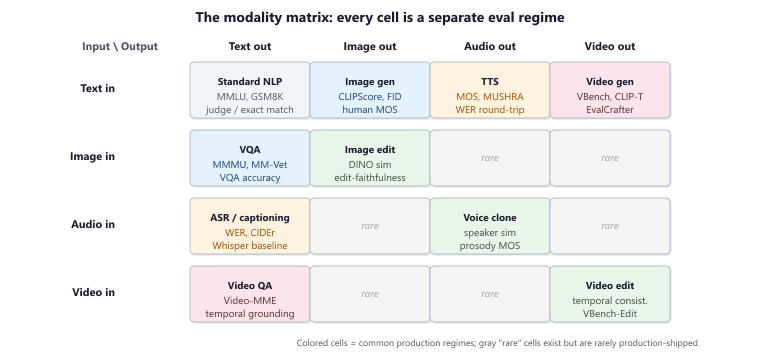
For a typical 2026 production agent, the relevant cells are usually four or five:
- Image-in, text-out (visual question answering, screenshot description, OCR-grounded reasoning): the largest body of benchmarks lives here. Metrics blend exact-match (for factual VQA), semantic similarity (for descriptive answers), and grounding accuracy (does the model point at the right region?).
- Audio-in, text-out (speech recognition, audio captioning, music tagging): dominated by word-error-rate (WER) and reference-based caption metrics. Reasonably mature.
- Text-in, image-out (image generation, image editing): dominated by CLIPScore for prompt fidelity, FID and KID for distributional realism, and human MOS-style scoring for aesthetic quality.
- Text-in, audio-out (text-to-speech, music generation): MOS, MUSHRA, and perceptual proxies like PESQ and ViSQOL. Highly subjective territory.
- Text-in, video-out (video generation): the youngest and least mature regime. VBench, EvalCrafter, and Veo/Sora-class evaluation harnesses are the current standards.
Two of the generation-quality metrics named above have a precise definition worth lifting out, because their range only makes sense once you see what they measure. FID (Frechet Inception Distance) embeds both the real and the generated images with a fixed encoder (the original proposal uses an Inception-v3 network; CLIP-based variants are now common), fits a Gaussian to each resulting feature cloud, and reports the Frechet (Wasserstein-2) distance between the two Gaussians:
$$\text{FID} = \lVert \mu_r - \mu_g \rVert^2 + \mathrm{Tr}\!\left(\Sigma_r + \Sigma_g - 2\,(\Sigma_r \Sigma_g)^{1/2}\right) .$$
Here $\mu_r, \Sigma_r$ are the mean and covariance of the real features and $\mu_g, \Sigma_g$ those of the generated features. The first term, $\lVert \mu_r - \mu_g \rVert^2$, is the squared gap between the two distribution centers (do the generated images sit, on average, where real images sit in feature space?), and the second term compares the covariance structure (do the generated images have the same spread and correlations across features?). FID is zero only when the two Gaussians coincide and grows as either the mean or the covariance diverges, so lower is better. KID (Kernel Inception Distance) measures the same distributional gap but as the squared maximum mean discrepancy (MMD) between the two feature sets under a polynomial kernel; unlike FID it is an unbiased estimator, so it stays reliable on the small sample sizes where FID's Gaussian fit is itself noisy.
BLEU and ROUGE were designed for translation and summarization. When a vision-language model describes an image, BLEU against a single human caption underrates correct descriptions that use different vocabulary ("a brown dog" vs "a chocolate Labrador"). For image captioning, prefer CIDEr (designed for the task), SPICE (which scores against scene-graph triples), or CLIPScore (which scores image-text alignment directly without a text reference). For VQA, use VQA Accuracy, which compares against a distribution of human answers rather than a single string.
One subtlety: in many 2026 production systems, the same model handles multiple modality combinations. GPT-4o, Gemini 2.5, and Claude Opus all consume images and audio while emitting text and (in some configurations) audio. The "single model, many combinations" pattern makes per-cell evaluation more important, not less: aggregating across cells obscures the failure modes that matter for each user-facing feature.
43.5.2 Vision-Language Evaluation
Vision-language evaluation has the deepest benchmark catalogue of any multimodal regime. The canonical benchmarks fall into four buckets, roughly ordered by difficulty:
- VQAv2 (Goyal et al., 2017): 1.1M open-ended questions about MS-COCO images, with balanced answer distributions. Easy by 2026 standards (frontier models score above 85%). Useful as a smoke test, not a discriminator.
- GQA (Hudson and Manning, 2019): compositional questions auto-generated from Visual Genome scene graphs. Tests counting, spatial relations, attribute comparison. Still meaningfully hard for small vision-language models.
- MMMU (Yue et al., 2024): 11,500 multi-discipline multimodal questions at college-exam level, spanning art, business, science, engineering. The reference benchmark for "does this model understand textbook-style figures?" Frontier models in 2025 score in the 60-70 range; humans score around 88.
- MM-Vet (Yu et al., 2024): 218 hard examples covering six integrated capabilities (recognition, OCR, knowledge, language generation, spatial awareness, math). Discriminative even among frontier models.
In production, you rarely run these benchmarks as written. Instead, you adapt the methodology: build a domain-specific eval set with the same question structure (multiple-choice for MMMU-style, open-ended with multi-reference scoring for VQA-style), and use the published scoring code to keep numbers comparable to the literature.
CLIPScore and its limits
CLIPScore (Hessel et al., 2021) is the workhorse metric for image-text alignment without a text reference. It computes the cosine similarity between a CLIP image embedding and a CLIP text embedding, then rescales to a 0-100 range. Its main virtue is that it does not require human-written captions: you can score generated text against the source image directly.
# Input: an image path and a caption string
# Output: CLIPScore in [0, 100] measuring image-caption alignment
import torch
from PIL import Image
from transformers import CLIPProcessor, CLIPModel

model = CLIPModel.from_pretrained("openai/clip-vit-large-patch14")
proc  = CLIPProcessor.from_pretrained("openai/clip-vit-large-patch14")

def clipscore(image_path: str, caption: str) -> float:
    image   = Image.open(image_path).convert("RGB")
    inputs  = proc(text=[caption], images=image, return_tensors="pt", padding=True)
    with torch.no_grad():
        out     = model(**inputs)
    img_emb = out.image_embeds / out.image_embeds.norm(dim=-1, keepdim=True)
    txt_emb = out.text_embeds  / out.text_embeds.norm(dim=-1, keepdim=True)
    cos     = (img_emb * txt_emb).sum(dim=-1).item()
    return max(0, 100 * 2.5 * cos)   # Hessel et al. recommended w=2.5

print(clipscore("cat.jpg", "a tabby cat sleeping on a sunlit windowsill"))CLIPScore has well-documented failure modes. It is insensitive to fine-grained correctness ("a brown dog" and "a brown cat" can score similarly if both match the background), it can be gamed by stuffing the caption with rare visually grounded nouns, and it inherits any bias present in the CLIP training corpus (LAION-style web pairs). Treat CLIPScore as a fast, cheap first-pass filter; pair it with task-specific metrics (VQA accuracy for question answering, CIDEr or SPICE when references exist) before making a release decision.
Screenshot grounding for web and GUI agents
Browser-using agents (the WebArena family, OSWorld, AgentBench's web split) require a different kind of vision-language eval: visual element matching. The model is shown a screenshot, asked to click a specific element, and the eval checks whether the predicted bounding box overlaps the ground-truth element. The standard metrics are IoU (intersection-over-union) at thresholds 0.25, 0.5, 0.75, and center-point accuracy (did the click land inside the element?).
The hard part is that production GUI agents emit pixel coordinates, not bounding boxes; the eval has to map clicks back to DOM elements (in browser cases) or to OCR-extracted regions (in pure-screenshot cases). WebArena resolves this by running the model's clicks against a real headless browser and scoring task completion downstream, which is more faithful to the user experience but much slower and noisier than a static IoU eval.
Run a fast, static element-localization eval (IoU against labeled bounding boxes) on every PR, and a slow, dynamic task-completion eval (full WebArena replay) on a nightly schedule. The static eval catches obvious regressions in seconds; the dynamic eval catches the regressions that only manifest with real DOM events. Reporting both, and tracking their divergence over time, surfaces the cases where the model's predicted clicks are technically correct but the resulting page state diverges from what the eval expected.
43.5.3 Audio Generation Evaluation
Audio output evaluation is older than LLM evaluation by several decades, and the metric landscape reflects that history. The traditional speech-synthesis literature divides metrics into three tiers: subjective listening tests, perceptual quality proxies, and content-fidelity scores.
MOS (Mean Opinion Score) is the gold standard for subjective audio quality. Listeners rate samples on a 1-5 scale (1 = bad, 5 = excellent), and the system score is the mean over many ratings. ITU-T Recommendation P.808 defines a crowdsourced MOS protocol that has become the de facto industry standard. The fundamental limitation is cost: a stable MOS estimate requires hundreds of listeners per condition, and the variance between studies makes cross-paper comparison unreliable.
MUSHRA (MUlti-Stimulus test with Hidden Reference and Anchor), defined in ITU-R BS.1534, is the more rigorous cousin of MOS. Listeners rate multiple systems on the same screen, with a hidden reference (high anchor) and a deliberately degraded low anchor; the relative scoring controls for listener-level rating drift. MUSHRA is the standard for high-quality audio (music codecs, neural vocoders) where MOS rating ceilings get crowded.
PESQ (Perceptual Evaluation of Speech Quality) and ViSQOL (Virtual Speech Quality Objective Listener) are automatic proxies for MOS. They model human auditory perception with hand-crafted (PESQ) or learned (ViSQOL v3) features. Both correlate reasonably well with MOS on conventional codec degradations, but they were trained on bandwidth-limited telephony audio and tend to mis-score modern neural-vocoder artifacts (smooth, low-distortion audio that nevertheless sounds wrong to humans). Use them as cheap CI gates, not as release decisions.
Prompt-adherence for TTS is a separate axis: does the generated speech actually say the requested text? The simplest metric is to run an ASR model (Whisper-large works well) over the generated audio and compute WER against the original prompt. A good neural TTS system should score WER below 3%; if WER drifts upward, something is breaking before listeners notice. For prosody and emotion, the field is still without a strong automatic metric, and most teams fall back on listening tests for the prosodic dimensions.
Music generation evaluation introduces yet another set of metrics. The MusicGen and Stable Audio papers report Fréchet Audio Distance (FAD), the audio analog of FID for images. FAD measures the distance between feature-space distributions of generated and reference clips (typically using VGGish or CLAP audio embeddings). Lower is better; under 4.0 is considered competitive on the MusicCaps benchmark.
Every two or three years, a paper claims to have "solved" automatic audio quality evaluation with a new neural metric. None of them have survived contact with the next generation of generation models. The reason is that audio quality is a multi-dimensional concept (naturalness, intelligibility, prosody, emotion, recording conditions, speaker identity) and any scalar proxy collapses too much. For production, plan to budget for human listening tests on every major model release. Automatic proxies are useful for catching regressions during training, but not for shipping decisions.
43.5.4 Video Generation Evaluation
Video generation is the newest and least mature of the modality regimes. Veo, Sora, Mochi, Kling, and the open-source models in their wake all rely on a handful of benchmarks that the field is still negotiating.
VBench (Huang et al., 2024) decomposes video quality into 16 dimensions: subject consistency, background consistency, temporal flickering, motion smoothness, dynamic degree, aesthetic quality, imaging quality, object class accuracy, multiple objects, human action recognition, color consistency, spatial relationships, scene consistency, appearance style, temporal style, and overall consistency. Each dimension has its own automatic scorer (a mix of CLIP-based, classifier-based, and optical-flow-based metrics). The total VBench score is a weighted average, but the per-dimension scores are what matter for diagnosis.
EvalCrafter (Liu et al., 2024) focuses on prompt-fidelity: does the generated video match the input text prompt? It scores along 17 axes including object recognition, action recognition, color matching, and motion description. It combines CLIP-T (CLIP text-image similarity, averaged across frames), action recognition scores from VideoCLIP, and text-conditioned video quality from a learned regressor.
Temporal-consistency metrics deserve their own attention. The simplest is per-frame CLIPScore between consecutive frames (high values mean the scene stays consistent), but this rewards static videos. The harder version is identity-preserving consistency: do the same characters and objects keep their identity over a 10-second clip? Subject-consistency benchmarks (VBench's "subject_consistency" score) use DINO-V2 feature similarity between detected subjects across frames as a proxy.
Motion smoothness is typically measured with optical-flow-based metrics: estimate dense flow with RAFT or GMFlow, then score the smoothness and physical plausibility of the resulting flow field. A model that produces sharp per-frame images but jagged motion will score well on per-frame quality and poorly on motion smoothness.
Prompt fidelity over frames
The standard text-to-video prompt-fidelity metric, CLIP-T over frames, samples N frames uniformly from the generated video, computes CLIPScore between the prompt and each frame, and averages. This is fast but coarse: it treats the prompt as a single attribute that must hold for every frame, when in practice prompts often describe actions (which only certain frames depict) or temporal events. EvalCrafter's action-recognition CLIP-T attempts to fix this by using action-grounded video encoders (VideoCLIP, X-CLIP) instead of frame-level CLIP, scoring against the action portion of the prompt rather than the static-scene portion.
An open-source video generation team optimized for CLIP-T-over-frames as their primary release metric. After three months of training, their CLIP-T scores were state-of-the-art on UCF-101 prompts, beating Veo by 4 points. Human raters compared the model head-to-head against the previous version and rated it worse on every axis except prompt fidelity. Investigation: the model had learned that minimizing inter-frame variation maximized CLIP-T (each frame independently matched the prompt, so averaging gave a high score), and as a side effect the videos had become nearly static. Fix: add motion-smoothness and dynamic-degree metrics to the release gate, with a hard floor below which the model could not ship. Lesson: single-metric optimization in video generation almost always finds a degenerate solution. Multi-axis gates are mandatory, not optional.
43.5.5 Multimodal RAG Evaluation
The 3-layer cake from Section 35.1 (retrieval, generation, end-to-end) extends to multimodal RAG with one extra layer: cross-modal retrieval.
In a text-only RAG system, retrieval recall is a single number: of the K chunks fetched, how many were relevant? In a multimodal RAG system, retrieval has at least three sub-metrics:
- Text-to-image recall: given a text query, does the retriever return the right images? Standard recall@K against a labeled set.
- Image-to-text recall: given an image query (a screenshot, a photo), does the retriever return the right text passages? Standard recall@K, often run with CLIP or BLIP-2 as the cross-modal encoder.
- Table and chart extraction accuracy: for documents with embedded structured content, did the retriever's extractor convert tables and charts into queryable text (or structured) representations correctly? Metrics here are domain-specific: table-cell exact-match for financial documents, chart-element recall for scientific papers.
The second tier (generation) measures whether the model used the retrieved multimodal context. The faithfulness-style metrics from Section 35.1 generalize: did every claim in the answer have support in the retrieved image OR text OR table? The hard part is that "support in an image" is harder to verify than "support in a text passage": you typically need a vision-language judge to check whether a specific claim is visible in a specific region of an image.
The third tier (end-to-end) is the same as text-only RAG: did the user's task get done? For multimodal RAG (typical use case: ask a question about a PDF that contains both text and figures), end-to-end accuracy is usually measured against a held-out QA set with human-labeled answers.
43.5.6 Cross-Modal Grounding: Where Did the Model Actually Look?
The most subtle multimodal evaluation problem is grounding: when the model's text references an image region ("the red car in the top-left"), did the model actually attend to that region? This matters because models can produce text that looks grounded (correct region descriptions, plausible spatial language) while internally relying on language priors (red cars are usually mentioned in car-photo captions, regardless of which region they occupy).
Two methods dominate:
- Grad-CAM overlap: compute Grad-CAM saliency maps on the model's image encoder, restricted to the tokens of the grounding phrase. Compare the high-saliency regions to the ground-truth bounding box using IoU. High overlap = real grounding; low overlap = the model said the right thing for the wrong reason.
- Attention-mask IoU: for transformer-based vision-language models, extract the cross-attention weights from the text tokens of the grounding phrase to the image patches. Threshold and binarize the attention map, then compute IoU with the ground-truth box. Less interpretable than Grad-CAM but cheaper to compute.
Both methods are imperfect proxies for "where the model looked," but they catch the most egregious cases (the model says "the bird in the tree" while its attention is entirely on the ground). In safety-critical applications (medical imaging, autonomous driving simulation evaluation), grounding scores are increasingly part of the release gate alongside accuracy.
Rather than relying on per-model saliency methods, a 2025 pattern in production is the grounding verifier: a second, smaller vision-language model that takes (image, claim, claimed region) and outputs a yes/no judgment about whether the region actually supports the claim. The verifier is trained on human-labeled grounding examples and is model-agnostic, so it can be used to score outputs from any frontier multimodal model. The downside is that it adds latency and cost; the upside is that it produces calibrated, interpretable grounding scores that don't depend on access to the generating model's internal attention.
43.5.7 Hard Cases: Subjective Quality, Creative Output, Domain-Specific Multimodal
Three classes of multimodal evaluation remain genuinely hard in 2026, and budget-aware teams should plan around them rather than pretend the existing metrics solve them.
Audio aesthetic and emotional quality: a TTS system that achieves perfect WER and good PESQ can still sound robotic, monotone, or emotionally flat. There is no automatic metric that correlates well with "this voice sounds engaging." Production teams running large TTS deployments (Eleven Labs, OpenAI Voice, character.ai voice) all rely on weekly or biweekly listening panels to catch aesthetic regressions that automatic metrics miss. The same is true for music generation: FAD measures distributional realism but says nothing about whether a track is good.
Creative image and video output: when a user asks for "a surreal landscape," there is no single correct answer. CLIPScore measures prompt-fidelity, FID measures distributional realism, but neither captures originality, aesthetic intent, or artistic coherence. The standard solution is preference-based evaluation: have human raters compare pairs of outputs and compute Elo ratings (Chatbot Arena-style). Lmsys's Imagen Arena, ai.aest.io, and similar leaderboards have become the de facto external evaluation for generative image and video models.
Domain-specific multimodal: medical imaging, radiology reports, satellite imagery, scientific figures. Each domain has its own metrics that often combine multimodal accuracy with task-specific correctness. For radiology AI, the joint metric is often (a) classification accuracy on the imaging finding plus (b) clinical-correctness score on the generated text report, with both having to clear a threshold for the system to ship. The MIMIC-CXR-JPG and RadGraph benchmarks define the standard scoring code, but every hospital system ultimately runs its own internal evaluation against local data. Plan for domain-specific eval infrastructure as a multi-quarter effort, not a one-week build.
The dominant open problems in multimodal evaluation as of 2026:
- Unified multimodal benchmarks: MMMU is a strong start for image-text, but there is no equivalent for audio, video, or cross-modal reasoning. Constructing a benchmark that simultaneously tests image, audio, and video understanding (and that resists contamination) is an active area.
- Embodied evaluation: for agents acting in physical or simulated environments (robotics, game-playing), the right unit of evaluation is task completion, not perception accuracy. The connection between perception metrics and downstream task success is poorly understood.
- Cross-cultural creative evaluation: aesthetic preferences vary across cultures; a Western-trained preference model rates Western-style images higher. Building culturally calibrated multimodal preference models is an open problem with major commercial stakes.
Explore Further: Take a frontier multimodal model and a small in-domain image set (50-100 images). Run CLIPScore, a vision-language judge model (GPT-4o or Claude Opus with a captioning rubric), and human ratings on the same outputs. Compute correlations between the three methods. The result is your team's calibration curve for choosing between cheap, medium, and expensive eval methods.
- Enumerate input-output modality pairs first. Each pair has its own benchmarks, metrics, and failure modes; aggregating across them hides regressions.
- CLIPScore is a fast first-pass metric, not a release gate. Pair it with reference-based metrics (CIDEr, SPICE) and task-specific scores (VQA Accuracy, MMMU).
- Subjective audio quality refuses to be automated. Budget for human listening tests on every major TTS or music-generation release.
- Video evaluation needs multi-axis gates. Optimizing for any single video metric (CLIP-T, motion smoothness, prompt fidelity) finds a degenerate solution.
- Grounding matters for safety-critical applications. Verify that the model actually attended to the region it referenced, not just that the language sounds correct.
Exercises
A model generates the caption "a small brown dog running through tall grass" for an image whose human reference is "a Labrador puppy bounding through a wheat field." Which of BLEU, CIDEr, and CLIPScore is most likely to give a high score, and why?
Answer Sketch
BLEU will score very low (almost no n-gram overlap; "a" is the only matching unigram). CIDEr will score moderately (it uses TF-IDF-weighted n-grams and rewards visually-grounded vocabulary, but still requires lexical overlap). CLIPScore will score highest, because it measures image-caption alignment via embeddings: both phrases map to similar visual concepts (small canine, vegetation, motion) in CLIP space. This is the classic case for using embedding-based or image-grounded metrics over n-gram metrics for image captioning.
Design a release gate for a text-to-video model that prevents the "static-video local optimum" failure described in the postmortem. Specify (a) which metrics to include, (b) what threshold each must clear, and (c) what to do when one metric improves while another regresses.
Answer Sketch
(a) Include at least four metrics: CLIP-T over frames (prompt fidelity), VBench motion smoothness, VBench dynamic degree (penalizes static videos), and human preference Elo against the previous release. (b) Each metric must clear an absolute floor (e.g., dynamic degree above the previous version's 10th percentile) AND not regress more than 2% relative to the previous release. (c) When one metric improves and another regresses, require manual sign-off from at least two reviewers, and ship only if human preference Elo is at least neutral. The principle: never let any single automatic metric outvote human preference.
Extend the CLIPScore code fragment in this section into a batch eval harness. The harness should accept a CSV of (image_path, caption) pairs, compute CLIPScore for each pair, and report mean, median, 10th percentile, and 90th percentile scores. Include a bootstrap 95% confidence interval for the mean.
Answer Sketch
Wrap the single-pair function in a loop over the CSV, accumulating scores into a list. Use numpy.percentile for the percentiles. For the bootstrap CI, resample the score list with replacement N times (typically 1000), compute the mean of each resample, and take the 2.5th and 97.5th percentiles of the resampled means. For efficiency on large eval sets, batch the CLIP forward pass: stack images and texts into batches of 32, run them through the model in one forward pass, then slice the resulting embeddings. This typically gives 10-20x speedup on a single GPU.
You are deploying a radiology-report-generation model. The model outputs a text report describing findings in a chest X-ray. Describe a grounding-verifier design that flags reports where the text references a finding the model did not actually attend to.
Answer Sketch
Build a separate vision-language verifier model that takes (image, generated_report_sentence, claimed_region) and outputs a yes/no judgment about whether the region supports the sentence. Train it on a small labeled dataset of (image, sentence, region, label) triples annotated by radiologists. At inference, for each sentence in the generated report, extract the model's attention map for the sentence tokens, threshold it to get a "claimed region," and pass to the verifier. If verifier rejects more than K sentences in a report, flag the entire report for human review. Tune K via ROC analysis against a held-out set of radiologist-reviewed reports.
You want to compare two TTS systems with a MOS test and detect a true difference of 0.2 MOS points with 80% power at alpha=0.05. Assuming a per-listener rating standard deviation of 0.8 and 5 ratings per listener per system, how many listeners do you need? Implement a power calculator.
Answer Sketch
Use a paired t-test power calculation. The effective standard error per listener is sigma / sqrt(n_ratings_per_listener) = 0.8 / sqrt(5) ~ 0.358. For 80% power at alpha=0.05 with a true effect of 0.2, the required number of listeners is roughly ((z_alpha + z_beta) * SE / effect)^2 = ((1.96 + 0.84) * 0.358 / 0.2)^2 ~ 25 listeners. In practice, plan for 1.5-2x this number (40-50 listeners) to account for listener-level rating drift and dropouts. Implement using statsmodels.stats.power.tt_solve_power for the exact calculation.
What Comes Next
The next section continues this chapter's tour of specialized evaluation regimes, picking up domain-specific eval (finance, healthcare, code, scientific), agent-trajectory evaluation, and long-context evaluation, each of which adds further axes that the metrics in this section do not cover. Continue to Section 44.4: Post-Launch Monitoring and Iteration.