"Pinterest Lens, Spotify AI DJ, YouTube generative discovery. The conversational-discovery pattern repeats across each, with one shared lesson: the catalog is the corpus."
Lexica, Discovery-UX-Reader AI Agent
Conversational discovery is the 2024-2026 frontier where LLMs interact most directly with the recommendation funnel that Section 73.8 mapped. Pinterest's Lens, Spotify's AI DJ and Daylist, YouTube's generative-search experiments, and Amazon's Rufus all share the same architectural pattern: an LLM mediates between the user's natural-language intent and the structured retrieval system, with the conversation acting as a clarification and refinement layer above the embedding-and-ranker stack. The regulatory frame is the EU Digital Services Act (DSA) recommender-transparency obligations, which apply to all large platforms by 2026 and require explicit explanations of why an item was recommended. This section walks the named-vendor cases and the regulatory posture that wraps them.
Prerequisites
This section assumes familiarity with the multi-stage recommendation funnel from Section 73.8, the LLM-as-reranker and LLM-as-explainer patterns from Section 73.9, the embedding-retrieval foundations from Chapter 31, and the RAG patterns from Chapter 32. The conversational-UX patterns build on Chapter 37.
Pinterest Lens: Cross-Modal Visual Discovery
Pinterest Lens launched in 2017 as a curiosity feature and crossed 1.5 billion searches per month by 2021, before CLIP was even widely deployed in industry. The original Lens model was a custom Pinterest-trained CNN; the migration to a CLIP-family architecture in 2022-2023 was hailed internally as the largest single-quarter accuracy improvement in the product's history. Spotify AI DJ launched in February 2023 with a synthetic-voice host who was modeled on a single Spotify in-house creative director's voice.
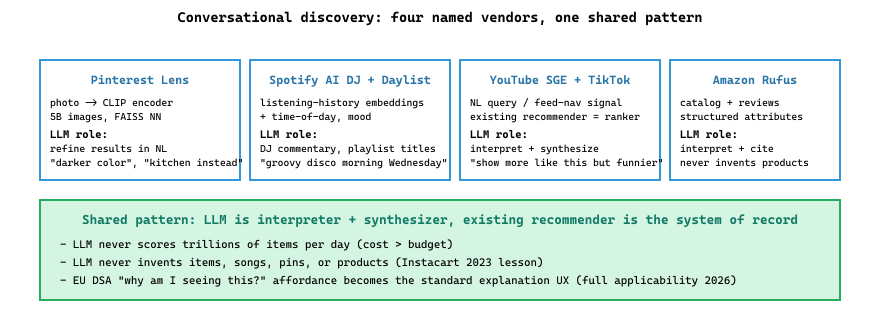
Pinterest's Lens feature (visual search by photograph) is the most-cited public reference for billion-scale cross-modal retrieval. The user photographs an object or scene, a CLIP-family encoder maps the photo into a shared embedding space, and approximate nearest neighbor search returns the most similar Pins from a catalog of over five billion images. The 2024-2026 evolution added an LLM layer that lets users refine results conversationally ("similar but in a darker color," "the same style but for a kitchen instead of a living room"), translating the natural-language refinement into either a vector arithmetic adjustment or a structured filter applied at retrieval time. Pinterest's engineering team has been public about the cost and quality benefits of sharing the embedding space across visual search, related-Pin recommendations, and ad targeting; the unified-embedding pattern is the kind of platform-thinking discipline that has spread across the recommendation industry through 2024-2026.
Spotify AI DJ and Daylist
Spotify's AI DJ and Daylist are the dominant references for music recommendation augmented by LLM-generated natural language. The architecture: shared audio and listening-context embeddings drive candidate generation and ranking; an LLM produces the personalized DJ commentary, the playlist titles, and the contextual narrative that frames each track. The deeper architectural lesson is that the LLM does not replace the recommender; the LLM produces the user-facing rationale that makes the recommender's choices feel intentional. Spotify reports measurable engagement gains from the conversational layer, primarily because users spend more time within a recommended session when the rationale is articulated. The pattern has been adopted by Apple Music's discovery features, YouTube Music's generative playlists, and Amazon Music's voice-driven playback experiences.
Spotify's Daylist feature generates a personalized playlist multiple times per day, each with a generative title that captures the mood and context ("groovy disco morning Wednesday," "cozy folk evening Sunday"). The architecture: a recommendation model produces the track list from the user's listening history, time-of-day signals, and inferred mood; a separate LLM (a small one, with the recommendation context structured into the prompt) produces the title and the optional description. The title is the most-shared element of the feature on social media, which feeds back into product growth. The lesson for practitioners: an LLM-generated user-facing rationale or label can produce engagement gains larger than equivalent investment in the underlying recommender, particularly when the rationale invites sharing or commentary. The investment cost is small relative to the recommender retraining cost, which is why the pattern has spread quickly.
YouTube and TikTok Generative-Discovery Patterns
YouTube and TikTok have both deployed conversational and generative-discovery features through 2024-2026, with different architectural emphases. YouTube's Search Generative Experience and the conversational refinement features layered on top of standard search use an LLM to interpret the natural-language query, decompose it into a structured retrieval against the YouTube index, and present synthesized results with citations to the underlying videos. TikTok's generative-discovery features focus less on natural-language query and more on natural-language navigation within the feed ("show me more like this but funnier," "less of this creator"), which translates to a feedback signal applied to the recommender's training data. Both companies have publicly emphasized the same operational discipline: the LLM is an interpreter and synthesizer, not the ranker, and the existing recommendation pipeline remains the system of record for what gets shown.
Amazon Rufus and E-Commerce Conversational Search
Amazon Rufus (launched in beta in 2024 and expanded through 2025-2026) is the most-cited reference for conversational shopping. The architecture combines an LLM with retrieval over the product catalog, customer review corpus, and structured product attributes. A user query like "good running shoes for a marathon that won't blister my heels" gets interpreted as a structured retrieval (running shoes, marathon-suitable, with heel-blister mitigation features) plus a semantic embedding for nuance. The LLM also handles follow-up questions ("which of these have the widest toe box?") by querying the structured product catalog and synthesizing the answer with citations to specific product pages. The operational discipline that has stabilized: the LLM never invents product attributes or prices, refuses to answer when the catalog does not have the data, and always provides a path back to the canonical product page. This is the e-commerce parallel of the manufacturing copilot's mandatory-citation discipline from Section 73.4.
The conversational layer is an interpreter, not a ranker. Every successful production deployment in 2024-2026 keeps the LLM between the user and the existing recommendation or search system, translating natural-language intent into structured queries and synthesizing structured results back into natural language. The LLM does not score billions of items; the existing recommender does. The LLM does not invent products, songs, or pins; it cites the ones the recommender surfaced. This architectural discipline is what makes the conversational features feel intelligent without being unreliable. Practitioners who try to put the LLM directly in the retrieval path tend to discover that the cost economics, the latency budgets, and the hallucination risk all argue for the interpreter-and-synthesizer pattern instead.
EU DSA Recommender Transparency
The EU Digital Services Act (DSA), fully applicable to Very Large Online Platforms by 2024 and to all in-scope platforms by 2026, requires recommender-system transparency: platforms must disclose the main parameters of their recommenders, offer at least one option that does not rely on profiling, and provide users with meaningful information about why a particular item was recommended. The 2024-2026 implementation pattern: every recommendation surface offers a "why am I seeing this?" affordance that produces an LLM-generated explanation (with the underlying recommender's signals as input), every platform offers a non-personalized feed mode, and the platform's transparency report documents the recommender's high-level architecture. The LLM is again the interpreter, in this case interpreting the recommender's signals into a user-readable rationale. The compliance discipline overlaps neatly with the user-experience benefit: a user-facing explanation that satisfies the DSA also tends to improve engagement, because users trust recommendations they understand.
Cold Start and the Long-Tail Story
One of the most-cited 2022-2026 LLM contributions to recommendation is the cold-start improvement: items with sparse interaction data (new products, niche videos, indie tracks) are now better-served because LLMs can interpret the item's metadata, description, and content directly, rather than relying on user-interaction signals that do not yet exist. The pattern: an LLM produces a rich semantic embedding from the item's metadata, the embedding lands in the same space as user-context embeddings, and the item becomes retrievable on its first day in the catalog. Spotify's editorial-LLM tagging of new releases, Pinterest's first-day-Pin interpretation, and Amazon's new-product surfacing all use varieties of this pattern. The cold-start improvement is one of the few recommendation-quality changes from the LLM era that is uncontroversially attributable to LLMs specifically (as opposed to better encoders generally).
Operational Discipline Checklist
Instacart's first conversational-search rollout in late 2023 put GPT-3.5 directly in the retrieval path: the model was asked to "recommend three healthy snacks under $5." The model returned coherent recommendations (Kind bars, Sahale glazed nuts, Annie's bunny grahams), and Instacart's catalog had two of the three. The third was a product the model had invented from a name pattern it had seen in training data; the customer added it to cart and got a refund instead of a snack. Instacart's 2024 architectural fix was the entire checklist below in one sentence: the LLM stops being the ranker and starts being the interpreter. The recommender pipeline returns 50 real product IDs, then the LLM picks three from that constrained set and writes the rationale. After the fix, the "invented product" failure rate dropped to functionally zero on a 50,000-query monthly audit, while the conversational quality remained indistinguishable in user surveys. The aha is that "interpreter, not ranker" is not a design preference but the difference between a feature that costs you refunds and one that doesn't.
- Keep the LLM as interpreter and synthesizer, not as ranker. The existing recommendation pipeline is the system of record for what gets shown.
- Cite the underlying items in every LLM response. Never invent products, tracks, or pins.
- Provide a "why am I seeing this?" affordance on every recommendation surface, with an LLM-generated explanation grounded in the recommender's signals.
- Offer at least one non-personalized feed mode for EU compliance and for users who want it.
- Use shared embeddings across discovery, recommendation, and ads surfaces wherever possible. The platform-thinking discipline is the cost and quality win.
- Treat cold-start LLM tagging as a first-class feature, not a backfill task. The first-day retrievability of new items compounds over the catalog lifecycle.
Cross-References to the Rest of the Book
- Chapter 31 covers the embedding and vector-database foundations that the conversational layer sits above.
- Chapter 32 covers the RAG patterns that the e-commerce conversational-search deployments rely on.
- Chapter 37 covers the conversational-UX patterns at technical depth.
- Chapter 33 covers the cross-modal retrieval techniques that Pinterest Lens and visual-search products are built on.
- Chapter 47 covers the safety and recommender-transparency disciplines, which intersect with the DSA compliance frame.
What's Next?
Next, in Chapter 74: Tools of the Trade: Industry Solution Stack, we move from the per-industry application surveys of this chapter to the cross-industry tooling and solution stack that powers them.