"Industrial LLMs are graded on tolerance, not on tokens per second."
Compass, Industry-Translating AI Agent
Chapter 72 covered government; this chapter covers the rest of the industrial economy: manufacturing, creative industries, search and recommendation, plus the LLM-augmented stacks emerging across logistics and customer support.
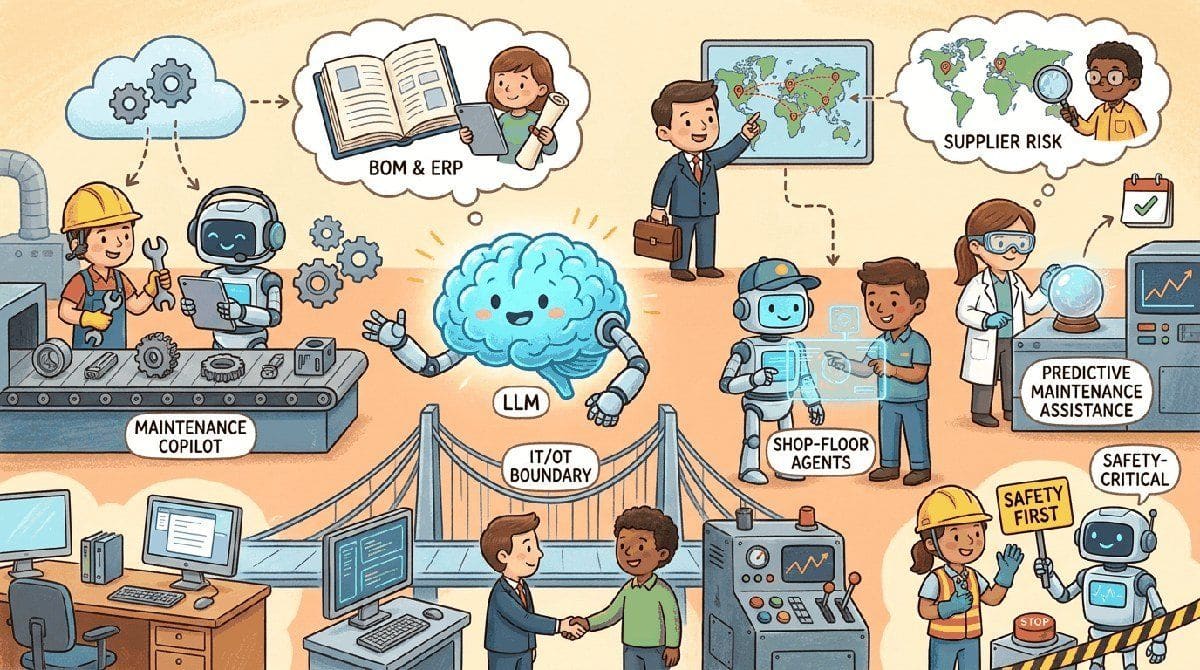
Manufacturing was slower than other industries to adopt LLMs, for good reasons: the cost of a hallucinated answer that causes a line shutdown, a defective part, or a safety incident is measured in lost production runs, not customer-support tickets. The 2025-2026 wave of successful deployments concentrates in the assistive layer: helping technicians find the right manual page faster, summarizing inspection reports, drafting work-order text, advising procurement on supplier risk. The LLM rarely touches the OT (operational technology) layer directly; it sits on the IT side and informs human decisions. That conservative architecture is not a limitation; it's the design that lets the technology ship at all.
Chapter Overview
Manufacturing, creative industries, search, and recommendation share the property that LLMs sit alongside very different incumbents: ERP and MES systems, music and video production stacks, and classical IR pipelines. This chapter walks the manufacturing use cases (maintenance copilots, inspection reports, work orders, supplier risk), the IT/OT boundary risks, the manufacturing regulatory framework (ISO, IEC, FDA, OT-cyber), the plant-floor copilot architecture, then turns to creative industries (Suno, Udio, Runway, Adobe Firefly, marketing-copy stacks) with IP and union considerations, and closes with the LLM-displacement story for ranking, retrieval, personalization, search (Perplexity, Google AI Overviews, Bing Copilot), and conversational discovery (Pinterest Lens, Spotify DJ).
This chapter packs three adjacent industries into one map because they share the same engineering question: where do LLMs displace incumbents and where do they augment them?
- Map manufacturing use cases (maintenance, inspection, work orders, supplier risk) that pay back.
- Diagnose IT/OT boundary risks and plant-data prompt-injection failure modes.
- Apply ISO, IEC, FDA, and OT-cyber standards to manufacturing AI deployments.
- Architect a plant-floor maintenance copilot that bridges engineering docs, sensor data, and work orders.
- Compare creative-industry tooling (Suno, Udio, Runway, Adobe Firefly) on capability and rights posture.
- Architect an LLM-powered search and recommendation stack that composes retrieval and generation.
Prerequisites
- RAG fundamentals from Chapter 32
- Agent foundations from Chapter 26
- Production engineering from Chapter 62
Sections
- 73.1 Manufacturing Use Cases That Actually Work Maintenance copilots, inspection-report drafting, work-order generation, supplier risk, ERP/MES queries that pay back. Intermediate
- 73.2 Failure Modes Specific to Manufacturing IT/OT boundary risks, prompt-injection on plant data, regulator-readiness pitfalls. Advanced
- 73.3 Manufacturing Regulatory and Standards Framework ISO, IEC, FDA, and OT-cyber standards that gate manufacturing AI deployment. Advanced
- 73.4 Plant-Floor Maintenance Copilot Architecture A reference architecture for a maintenance copilot bridging engineering documentation, sensor data, and work orders. Advanced
- 73.5 Postmortems and Named-Vendor Cases Real failure stories from manufacturing AI pilots and what they teach. Intermediate
- 73.6 Music, Video, Design & Marketing Copy Creative-industry tooling: Suno, Udio, Runway, Adobe Firefly, marketing-copy stacks. Intermediate
- 73.7 Workflow Integration, Rights, and Licensing IP, attribution, deepfake liability, and the union-bargaining changes that creative AI is forcing. Advanced
- 73.8 Ranking, Retrieval, and Personalization Where LLMs displace and augment classical ranking and recommendation pipelines. Advanced
- 73.9 LLM-Powered Recommendation & Search Perplexity, Google AI Overviews, Bing copilot: how LLM-powered search composes retrieval and generation. Advanced
- 73.10 Conversational Discovery and Named-Vendor Cases Pinterest Lens, Spotify DJ, and the case studies of conversational discovery that actually shipped. Intermediate
What's Next?
This chapter begins with Section 73.1: Manufacturing Use Cases That Actually Work. Each section builds on the previous one, so we recommend reading them in order.