"Music, video, design, marketing copy. The four creative industries that moved fastest from 'interesting demo' to 'in the production pipeline'."
Sparky, Creative-Pipeline-Reader AI Agent
Creative industries were the first sector where generative AI moved from "interesting demo" to "default tool" within roughly 18 months. Music, video, design, and marketing copy are all domains where the output is judged on aesthetic and brand fit rather than on a single correct answer, which is exactly the kind of task generative models are good at. By 2026, the major design suites ship AI features as defaults, the major streaming platforms compete on the quality of their generative music recommendations, and the major advertising agencies have rebuilt their creative pipelines around generative iteration. This section surveys the tools and workflows that have emerged, focusing less on which model is in vogue this quarter and more on the production patterns that have stabilized: how creative teams actually use these systems, where they fail, and what the legal and ethical guardrails look like when the output is going on a billboard.
Prerequisites
This section builds on the multimodal generation foundations from Chapter 20 (image, video, and audio generation) and the editing patterns from Chapter 33. Familiarity with the safety and watermarking practices from Chapter 47 is important for any commercial creative workflow.
What unifies music, video, design, and copy as "creative" is that the deliverable is not a single right answer but a piece of work that has to land. A marketing tagline that is technically correct but emotionally flat fails. A logo concept that follows the brief but looks generic fails. A 30-second ad cut that hits the runtime but lacks rhythm fails. Generative models, perhaps surprisingly, turn out to be well-suited to this setting precisely because they are trained on enormous corpora of work that did land: hit songs, viral videos, award-winning design. They are statistical models of taste as much as they are statistical models of pixels or notes.
The structural change that happened between 2023 and 2026 is that creative work has shifted from "generate from a blank page" to "iterate with an AI collaborator." The first wave of generative tools (DALL-E 2, GPT-4 for copy, Suno v1) sold themselves as one-shot generators: type a prompt, get an output. That framing has lost. The winning workflow is variation generation at high volume, followed by human selection and editing. Designers do not ask Midjourney for "the logo"; they ask for 60 logo concepts in 10 minutes and pick three to develop. Copywriters do not ask ChatGPT for "the tagline"; they generate 50 and pick the one their gut likes. This is the same pattern that took hold in software with autocomplete: the AI does not replace the human's judgment, but it does collapse the cost of options.
73.6.1 Image and Design Tools: Adobe Firefly, Midjourney, Canva
Adobe Firefly's signature "safe for commercial use" claim was made possible by training only on licensed Adobe Stock content, a corpus of roughly 300 million images. The deal Adobe cut with its stock contributors (a per-image royalty paid out of Firefly subscription revenue) was so unusual that it triggered a wave of contributor opt-ins; Adobe Stock's contributor count grew faster in 2023 after Firefly launched than in any prior year.
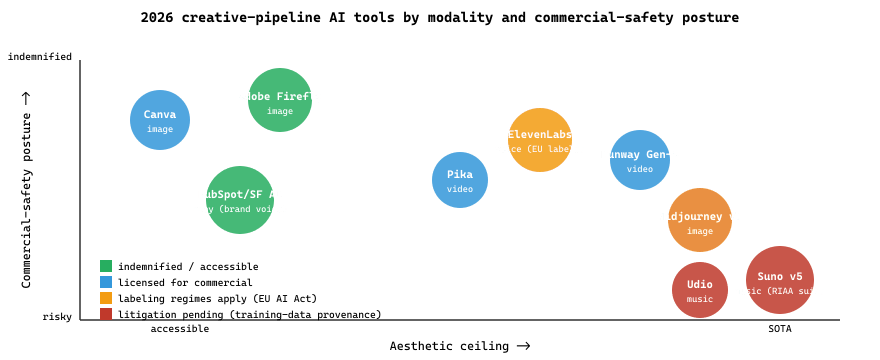
Adobe was the first major incumbent to ship a fully integrated generative AI tool, branded Firefly. The pitch was less about model quality (Firefly is competent but not state of the art) and more about indemnification: Adobe trained Firefly on Adobe Stock content with explicit licensing, and offers customers legal cover when they use generated images in commercial work. For ad agencies and in-house brand teams, "is this output legally safe to ship?" matters more than "is this output 5% prettier than a competitor's." Firefly Image 3, the 2024 model, and the Generative Fill feature in Photoshop are now default tools in most professional design workflows.
Midjourney occupies the aesthetic ceiling. Its v6 and v7 outputs remain the benchmark for image quality in the industry, and Midjourney has built a loyal user base among illustrators, concept artists, and creative directors who want maximum control over style. The model is famously opinionated: a Midjourney prompt without modifiers will produce a strong aesthetic by default, which is either delightful or constraining depending on what you want.
Canva integrated AI image generation through Magic Studio and now ships AI features as the default in its consumer and small business plans. The strategic lesson Canva proved is that the model itself is not the moat; distribution, templates, and a non-intimidating UI are. Most generated images in commercial use are made on Canva, not on Midjourney, even though Midjourney makes prettier pictures, because Canva is where the marketing intern sits.
Brand consistency is the unsolved problem. Generating one beautiful image is easy. Generating fifty beautiful images that all feel like they belong to the same brand campaign, with consistent character likenesses, color palette, and visual language, is hard. The 2025-era solution is reference-conditioned generation: brand teams curate a "brand reference set" (typically 20 to 100 hand-approved images), and generators are fine-tuned or LoRA-adapted on that set. Tools like Adobe Express Brand Kit and Canva Brand Hub bake this in as a first-class feature. Treat brand-consistency tooling as a required platform feature, not a nice-to-have, for any team shipping creative at scale.
73.6.2 Video Generation: Runway Gen-4, Pika, and the Production Pipeline
Video was the laggard modality through 2023; by 2025 it had caught up. Runway's Gen-4 and Gen-4.5 produce 10-second clips at 1080p with coherent motion, consistent characters, and reasonable physical plausibility. Pika took a different tack, focusing on character animation and lip-sync rather than on photorealistic scenes, and dominates the social media creator segment. Both products ship to consumers and to professional studios, with different feature emphasis (Pika favors speed and shareability; Runway favors editorial control and integration with existing NLE software).
The production pipeline that has emerged at major ad agencies and streaming services treats AI-generated video as one element in a layered timeline rather than as the final output. A typical workflow: storyboards generated with image AI, key frames produced in Midjourney or Firefly, motion interpolation done with Runway or a fine-tuned Stable Video Diffusion variant, and final compositing handled in After Effects or DaVinci Resolve. The AI replaces the most expensive step (initial production) but not the editorial polish step, where human craft still differentiates a passable cut from a great one.
73.6.3 Music and Audio: Suno, Udio, and ElevenLabs
Suno's v5 model produces complete songs (with vocals, instrumentation, and lyrics) from a text prompt in under 60 seconds. The output is good enough that the platform crossed 100 million users in its first 18 months and generated a serious lawsuit from the RIAA over training data provenance. Udio competes in the same space with slightly different aesthetic defaults. For non-vocal music (background scores, soundbeds, jingles), the use case is uncontroversial and commercially settled. For vocal music that resembles named artists, the legal status is unresolved as of mid-2026, with active litigation in multiple jurisdictions.
ElevenLabs is the dominant voice AI platform for narration, dubbing, and audio production. Its multilingual voice cloning is used by audiobook publishers, podcasters, and accessibility teams to produce high-quality narration at a fraction of human studio cost. The platform has worked harder than most on consent and watermarking, but the technology is dual-use and the regulatory landscape is tightening: the EU AI Act requires explicit labeling of AI-generated voice content, and several US states have passed similar laws.
73.6.4 Marketing Copy and Brand Voice
Marketing copy was the first creative domain LLMs disrupted, and by 2026 the disruption is complete. Every major marketing automation platform (HubSpot, Salesforce Marketing Cloud, Mailchimp) ships LLM copy generation as a default feature. The interesting workflow problem is not "can the LLM write a tagline?" (yes) but "can the LLM write copy that sounds like our brand?" The answer is yes if the brand voice is well-documented and prompts include rich examples, and no if the brand voice is implicit and undocumented.
The production pattern that has stabilized is a brand-voice document or fine-tuned model that captures the brand's tone, vocabulary, and stylistic constraints, plus a prompt template that incorporates the campaign brief and call-to-action. With these in place, an LLM can produce dozens of headline variations, body copy options, and channel-specific adaptations in minutes, with the copywriter shifting from "draft from scratch" to "curate and refine." Senior copywriters report that the role has become more editorial: less typing, more taste-making.
73.6.5 A Worked Case: Brand-Consistency Drift at Campaign Scale
The surveys above name the tools but not the mechanism that makes a creative pipeline ship or fail at scale. The recurring failure is not bad single outputs; it is silent brand drift across a high-volume batch, and the discipline that catches it is an automated brand-conformance gate. The worked case below carries one production deployment through that loop (scenario, pipeline, the concrete failure, how it was detected and evaluated, and the fix) so the section teaches a transferable evaluation mechanism rather than a vendor inventory. It is the creative-industries analogue of the mandatory-citation safety case that anchors the manufacturing copilot in Section 73.4: the artifact that turns a demo into a shippable system is the automated gate, not the generator.
Scenario. A global consumer brand runs a localized display-ad campaign across roughly 40 markets. Each market needs the same hero concept rendered in dozens of size-and-format variants with locale-appropriate copy, so the brief expands to several thousand generated assets on a weekly cadence: far past what a human studio can hand-craft, and exactly the high-volume variation regime where generative iteration earns its place.
Pipeline. The team builds the reference-conditioned generation pipeline from the Key Insight above. A curated brand reference set of about 60 hand-approved images LoRA-adapts an open-weight diffusion backbone for the visuals; a brand-voice prompt template (Section 73.6.4) drives an LLM for the locale copy. A human art director approves a small golden set per market, and the rest of the batch is generated unattended overnight.
The failure. Three weeks in, a market manager flags that the brand's signature accent color has crept warmer across an entire market's batch, and the product is rendered with a subtly wrong logo placement. No single image is obviously broken, which is why human spot-checks missed it: each asset looks plausible in isolation. The drift came from a LoRA checkpoint refreshed with a few new seasonal reference images that shifted the adapter's color prior, a regression that compounds silently across thousands of outputs.
Detection and evaluation. Spot-checking does not scale to thousands of weekly assets, so the team adds an automated brand-conformance gate that scores every generated asset before it can ship. The gate is mechanical and cheap. For color fidelity, it computes the distance between each asset's dominant-palette colors and the locked brand palette in a perceptually uniform space (CIEDE2000 in CIELAB), and rejects any asset whose nearest brand-color match exceeds a tolerance. For layout and likeness, it embeds each asset with the same CLIP-family encoder used for retrieval and measures cosine similarity to the centroid of the approved reference set, flagging outliers below a learned threshold. A small vision-language model runs a rubric check ("logo present, unobscured, in an approved corner; no extra fingers or warped product geometry") and emits a structured pass or fail. Running the gate retroactively on the shipped batch surfaced the warm-accent drift as a cluster of CIEDE2000 failures concentrated in one market, which is what turned a vague "something feels off" report into a reproducible, localized defect.
The fix. The team pins and versions the LoRA checkpoint (no silent refreshes), makes the brand-conformance gate a blocking step in the batch pipeline rather than an afterthought, and adds the perceptual color tolerance and the reference-centroid similarity floor to a regression suite that every adapter update must pass before it can generate a shippable asset. The structural lesson mirrors Section 73.4 precisely: at volume, the value is in the automated conformance gate and the versioned reference set, not in the generator. A pipeline without a brand-conformance gate is the creative equivalent of a maintenance copilot without mandatory citation. It works in the demo and drifts in production.
One deliberate scoping note: this case is about conformance, the engineering of getting thousands of assets to stay on-brand, not about whether those assets are legally safe to ship. The rights, indemnification, and provenance machinery (C2PA content credentials, platform indemnification tiers, the active IP litigation) is the subject of Section 73.7 and is not duplicated here. The brand-conformance gate is necessary but not sufficient: an asset can pass every color-and-likeness check and still carry a licensing problem, which is exactly why the provenance discipline in the next section wraps around the conformance discipline in this one.
In September 2023, Coca-Cola launched Coca-Cola Y3000, a limited-edition flavor marketed as "co-created with artificial intelligence." The campaign used AI image generation (via the company's "Create Real Magic" platform built with Stability AI and OpenAI) to produce promotional artwork imagining what humanity will look like in the year 3000, with user-submitted prompts contributing to the visual identity of the launch. The technical execution was straightforward (Stable Diffusion fine-tuned on Coca-Cola brand assets); the marketing innovation was using AI participation as the campaign concept itself. The campaign launched across more than ten markets including the USA, Canada, Australia, and China. The lesson for creative teams: when AI is the campaign narrative, the question is no longer "did AI help make this?" (it always did) but "is the AI involvement the story we want to tell?" Sometimes yes (Y3000, Heinz's earlier "AI-generated ketchup" campaign with Rethink agency), sometimes the opposite (luxury brands going to great lengths to certify "no AI involved" in handcrafted product photography).
The legal landscape around AI-generated creative work is unsettled. Three issues recur:
- Training data licensing (the RIAA's suit against Suno, the New York Times' suit against OpenAI, the Getty Images suit against Stability AI).
- Authorship and copyright eligibility (the US Copyright Office has held that purely AI-generated work is not copyrightable, but the boundary on "purely" is litigated).
- Right of publicity for AI-generated likenesses and voices.
Build a clear chain of provenance using C2PA content credentials for every piece of creative output, document which models and prompts were used, retain a paper trail of human creative decisions, and have your legal team review the workflow before scaling to production.
What Comes Next
Section 73.7 revisits creative industries alongside education and legal services, the original "knowledge work" verticals that LLMs disrupted first. The thread that connects this section to the next is that creative production at scale is now a hybrid human-AI workflow in every major industry; the difference is in which steps still require human judgment, which has been automated, and which are caught in a regulatory or ethical limbo. Section 73.7 zooms out from creative-specific tooling to the broader pattern of human-AI collaboration that has defined the 2024 to 2026 transition.
What's Next?
In the next section, Section 73.7: Workflow Integration, Rights, and Licensing, we build on the material covered here.