"Foxconn Foxbrain, Siemens Industrial Copilot, the 2024 torque-spec pilot. Three named cases that taught the industry how an LLM on a plant floor actually behaves."
Sage, Plant-Floor-Case-Reader AI Agent
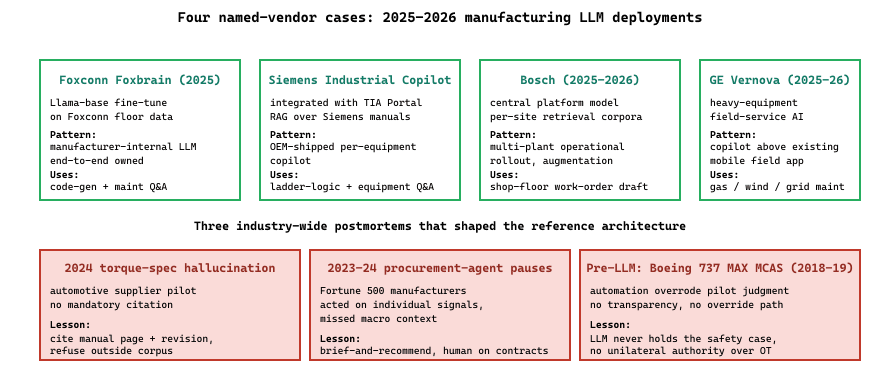
Four named-vendor cases anchor the 2025-2026 manufacturing LLM story, and three industry-wide postmortems explain why the architecture in Section 73.4 looks the way it does. Foxconn's Foxbrain and Siemens Industrial Copilot represent the manufacturer-internal and OEM-shipped patterns respectively; Bosch and GE Vernova represent multi-plant operational rollouts; the 2024 torque-spec pilot, the 2023-2024 procurement-agent pauses, and the cross-industry MCAS lesson explain the failure modes the architecture was designed to defend against. This section reviews each in production-pattern terms rather than as marketing or news items.
Prerequisites
This section assumes the plant-floor copilot architecture from Section 73.4 and the LLM evaluation methodology from Section 42.1.
Foxconn Foxbrain: Manufacturer-Internal LLM
The Siemens Industrial Copilot, integrated with TIA Portal, was reportedly first demoed publicly in March 2024 by drag-and-dropping a natural-language description into a PLC ladder-logic editor and watching the rungs auto-generate. Siemens engineers reportedly debated whether to call the product "Codeline" or "Industrial Copilot" right up to the day of the press release; the more boring name won.
In 2025 Foxconn (Hon Hai) publicly announced Foxbrain, an internal LLM built on a fine-tuned Llama base and trained on the company's own production-floor data and proprietary documentation. The deployment pattern is the manufacturer-internal version of the reference architecture: a single base model owned by Foxconn's central AI team, served on Foxconn-controlled infrastructure, with retrieval corpora that include production-floor SOPs, equipment manuals, and historical defect-resolution records. Reported use cases include code generation for industrial-automation tasks, report drafting, and engineering Q&A; production-floor maintenance copilot use is a substantial fraction. The strategic point Foxconn emphasized in its announcement is that the company controls the model end to end: training data, weights, fine-tunes, and inference infrastructure. This pattern is increasingly attractive for large manufacturers whose data volumes and regulatory exposure justify the in-house investment over a generic vendor deployment. Several other large Asian and European manufacturers have followed with comparable in-house programs through 2025 and 2026.
Siemens Industrial Copilot: OEM-Shipped Pattern
The Siemens Industrial Copilot is the most-cited reference for an industrial-OEM-shipped maintenance copilot. Siemens integrated the copilot with TIA Portal, the company's engineering and automation environment, with retrieval over Siemens equipment documentation and customer-specific configurations. The OEM-shipped pattern has two architectural strengths: the OEM understands the underlying equipment far better than any third-party vendor could, and the data-licensing story for the equipment-manual corpus is straightforward (the OEM owns the manuals). The trade-offs are commercial: the OEM controls the upgrade cadence and the licensing terms, and customers using equipment from multiple OEMs end up running multiple copilots. The pattern that has stabilized in practice is OEM copilots for OEM-specific equipment-Q&A, with the manufacturer's own copilot covering cross-equipment workflows like work-order drafting and shift handover.
Bosch and GE Vernova: Multi-Plant Operational Rollouts
Both Bosch and GE Vernova publicly described 2025-2026 rollouts of plant-floor copilots across global site portfolios. Bosch's deployment, summarized in Section 73.4, emphasizes the per-site retrieval and central-platform model that the reference architecture prescribes. GE Vernova focuses on energy-sector heavy-equipment maintenance (gas turbines, wind turbines, grid hardware), with the copilot acting as a layer above the company's existing field-service mobile applications. Both report measurable productivity outcomes on covered asset classes and both stress the same architectural discipline: the LLM is an information layer above the existing field-service workflow, not a replacement for it.
The successful manufacturing LLM deployments in 2025-2026 are the ones that augment an existing workflow, not the ones that try to replace it. Foxconn's engineers were already using internal documentation; Foxbrain just made retrieval and synthesis dramatically faster. Bosch and GE Vernova's field-service technicians already used mobile applications; the copilot just made those applications more conversational. The deployments that paused or failed (covered next) are the ones that tried to install the LLM as an authoritative decision-maker rather than as an information layer. The pattern is the same in legal (Section 67.2), healthcare (Chapter 69), and government (Chapter 72): augmentation ships, replacement does not.
The 2024 Torque-Spec Hallucination Pilot
A major automotive supplier piloted a maintenance copilot in 2024 without mandatory source citation. Technicians caught two fabricated fastener torque specifications during evaluation, both of which would have caused dangerous fastener over-torque or under-torque if applied on the floor. The project was paused, the architecture was rebuilt around mandatory citation and refusal-when-uncertain, and the supplier subsequently shipped a production version. Public after-action notes are sparse but the lesson has spread industry-wide and is now the standard cautionary tale in manufacturing LLM training. The architectural response, codified in Section 73.4: every specification or procedural reference must resolve to a citation, the system refuses to answer when the corpus does not contain the spec, and safety-related answers carry an explicit "verify with the printed manual" prompt before the technician acts.
The 2024 torque-spec pilot is the manufacturing equivalent of the 2023 ChatGPT fabricated-case-law incident in legal practice. Both were caught during evaluation rather than in production, both were due to the absence of mandatory source verification, and both produced architectural responses that became industry standard. Treat the hallucinated torque spec as a permanent reminder that mandatory citation, refusal outside corpus, and verification prompts are not optional features. They are the safety-case core.
The 2023-2024 Procurement Agent Pauses
Several Fortune 500 manufacturers tried fully-autonomous procurement-rerouting agents in 2023 and 2024. All of them paused after the agents made commercially-bad calls during volatile geopolitical events (sanctions announcements, port closures, supplier bankruptcies) that humans would have recognized as anomalous. The agents acted on individual signals without integrating the macro context that an experienced procurement leader carries in their head. The successful redesigns put the LLM in the briefing-and-recommendation seat with humans on the contracts, the supply-chain disruption advisor pattern from Table 73.5.1a. The deeper lesson, repeated in Chapter 28 on multi-agent systems and Section 49.1 on agent safety, is that autonomous-execution agents in commercial settings need an explicit, narrow scope and a human in the loop on any decision with material commercial impact. The 2023-2024 procurement-agent failures gave the industry that lesson at scale.
Pre-LLM but Instructive: Boeing 737 MAX MCAS
The 2018-2019 Boeing 737 MAX MCAS accidents are not an LLM case, but the institutional lessons are directly relevant to LLM use in safety-critical manufacturing. MCAS was an automated system that could override pilot judgment in a safety-critical function, with insufficient transparency to the pilots about when it would activate and how to override it. The post-accident reviews emphasized rigorous safety case, no single point of override, and explicit handoff to humans for any function that can affect safety. Those three principles, applied to LLM deployments in manufacturing, produce exactly the architectural discipline in Section 73.4: the LLM is never the safety case, the LLM never has unilateral authority over an OT actuator, and any handoff to humans is explicit and rehearsed. The MCAS case is taught in manufacturing-LLM training programs as a reminder that the institutional failure modes around safety-critical automation predate LLMs by decades.
Where to Read More
- Chapter 24 (Robotics, Embodied AI & Scientific Discovery), the closest in-book chapter to manufacturing-floor automation and the natural next read for teams pushing beyond information layers.
- Section 49.1 (Agent Safety & Prompt Injection Defense), relevant to any tool-using agent connected to operational systems.
- Section 53.3 (LLM Risk Governance & Audit), the governance frame that wraps the regulatory mapping in Section 73.3.
- Section 57.2 (Enterprise Integration Patterns), the ERP and MES handoff patterns at platform level.
- The production-patterns playbook, now part of Chapter 62 LLMOps coverage; source-quality-gate, sandboxed-execution, and one-command-rollback patterns are manufacturing essentials.
Read Section 73.1 for the use-case map, then Section 73.2 for the failure modes, then Section 73.3 for the regulatory frameworks, then Section 73.4 for the reference architecture, then this section for the postmortems. The order matters: practitioners who jump straight to the reference architecture without internalizing the failure modes and the regulatory frameworks tend to build the right pattern for the wrong reasons, which makes the deployment fragile when conditions change. The full sequence is the safety-case narrative.
What's Next?
In the next section, Section 73.6: Music, Video, Design & Marketing Copy, we build on the material covered here.