"A model that can describe a sound effect should be able to make one. A model that can recognize a melody should be able to hum it back."
Pixel, Any-To-Any AI Agent
"Any-to-any" generation is the goal of a single model that can consume any modality and produce any modality. Given a text prompt, the same model produces text, image, audio, or video. Given an image plus text, it produces a new image or describes it in audio. NextGPT, AnyGPT, Unified-IO 2, and CoDi-2 were the academic prototypes through 2023-2024; Gemini 2.0 and Llama-4-Omni are the frontier instantiations in 2025. The dominant pattern: an LLM core that emits semantic latents, plugged into modality-specific diffusion decoders. This section looks at the architecture, the training recipe, and the open questions that keep any-to-any from being a clean solved problem.
Prerequisites
This section assumes the unified vision-language pipelines from Section 22.1 through Section 22.6, the audio-codec tokenization from Section 20.1, and the diffusion-model basics from Section 19.7.
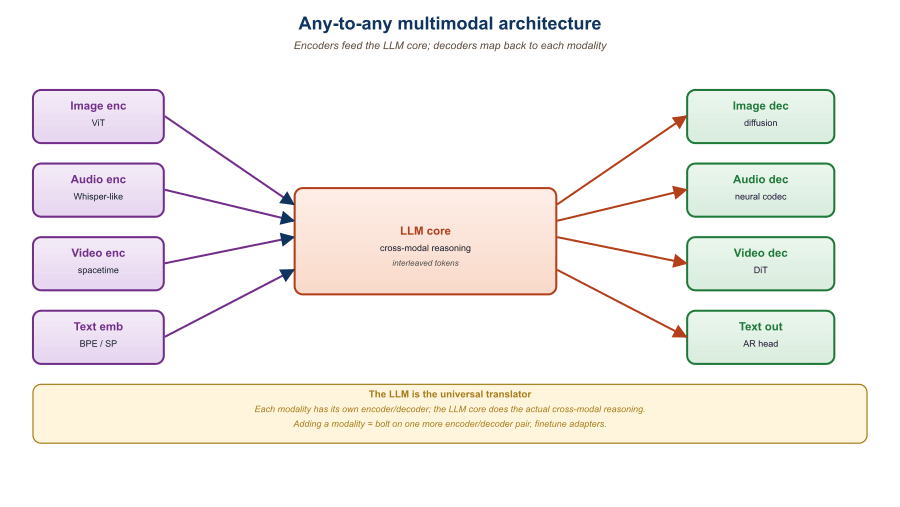
22.8.1 The Encoder-LLM-Decoder Pattern
Any-to-any models like NextGPT and AnyGPT make a curious claim about the universality of tokens: if you can discretize a modality, you can put a transformer on top of it. The training-data bottleneck is so severe that NextGPT was trained on roughly 6,000 audio-text-image triples, a number small enough to fit on a single thumb drive.
The dominant any-to-any recipe, used by NextGPT (Wu et al., 2023), Unified-IO 2 (Lu et al., 2023), and CoDi-2 (Tang et al., 2024), looks like this:
- Input encoders: each modality has its own encoder (ImageBind, CLAP, BEATs, ViT). Encoders produce embeddings projected into the LLM's embedding space, the mid-fusion pattern from Section 22.7.
- LLM core: a text LLM (Vicuna, Mistral, Llama) that processes the unified input embedding sequence and emits an output embedding sequence containing both text tokens and special "modality tokens" that signal a generation request.
- Output decoders: when the LLM emits a modality token, the corresponding decoder (Stable Diffusion for images, AudioLDM for audio, Zeroscope for video) consumes a learned latent the LLM produces and synthesizes the output.
The architecture is intentionally modular: each piece (vision encoder, LLM, image decoder) is pretrained independently, and only thin alignment layers are trained jointly. Training cost is a fraction of a frontier omni model's, which is why this pattern dominated 2023-2024 academic work.
22.8.2 NextGPT and the Alignment Tokens
NextGPT (Wu et al., 2024) introduced the trick of generation alignment tokens. Special tokens like [IMG] and [/IMG] mark spans in the LLM's output that should be interpreted as image-generation requests. The hidden states at those positions are projected into a fixed-size latent that becomes the conditioning input to a frozen Stable Diffusion decoder.
# Schematic of NextGPT-style any-to-any inference.
# The LLM emits special tokens that route generation
# to modality-specific decoders.
def any_to_any_generate(model, prompt):
    output_tokens, output_hidden = model.llm(prompt)
    results = []
    i = 0
    while i < len(output_tokens):
        tok = output_tokens[i]
        if tok == "[IMG]":
            # Find matching close tag; pool the hidden states inside
            j = output_tokens.index("[/IMG]", i)
            latent = model.image_projector(output_hidden[i:j].mean(dim=0))
            img = model.stable_diffusion(cond_latent=latent)
            results.append(("image", img))
            i = j + 1
        elif tok == "[AUD]":
            j = output_tokens.index("[/AUD]", i)
            latent = model.audio_projector(output_hidden[i:j].mean(dim=0))
            aud = model.audio_ldm(cond_latent=latent)
            results.append(("audio", aud))
            i = j + 1
        else:
            results.append(("text", tok))
            i += 1
return results22.8.3 AnyGPT: Discrete Tokens Across All Modalities
AnyGPT (Zhan et al., 2024) takes the early-fusion route to its logical end. Every modality is tokenized into a discrete vocabulary:
- Text: byte-pair encoding.
- Image: SEED-Tokenizer, a 256-token codebook per 256x256 image.
- Audio: SpeechTokenizer, a residual-VQ codec with 8 codebooks per frame.
- Music: Encodec, RVQ-style codec.
The model is a single autoregressive transformer trained on interleaved sequences of these discrete tokens. Inputs and outputs use the same vocabulary; the model picks which to emit based on conditioning. Training data is constructed by pairing text descriptions with tokenized media (LAION images, AudioCaps audio, MusicCaps music).
The pure-discrete approach is elegant but lossy: the tokenizers introduce a quality ceiling. AnyGPT compensates by chaining a high-quality continuous decoder after the discrete output, the discrete tokens act as a semantic plan that a downstream diffusion model fleshes out. This is the same pattern that GPT-4o image generation appears to use.
| Model | Input Modalities | Output Modalities | Architecture | Released |
|---|---|---|---|---|
| NextGPT | text, image, audio, video | text, image, audio, video | LLM + alignment tokens + diffusion decoders | 2023 |
| Unified-IO 2 | text, image, audio, video, depth, normals | text, image, audio | Encoder-decoder transformer + VQ tokenizers | 2023 |
| AnyGPT | text, image, audio, music | text, image, audio, music | Single autoregressive transformer over discrete tokens | 2024 |
| CoDi-2 | text, image, audio, video | text, image, audio, video | LLM + LDM with cross-modal attention | 2024 |
| Llama-4-Omni | text, image, audio, video | text, image, audio | Native early-fusion + diffusion image head | 2025 |
| Gemini 2.0 | text, image, audio, video | text, image, audio | Native multimodal + agent tooling | 2024-2025 |
The 2024-2026 consensus pattern: use a discrete LLM to plan the output (a sequence of semantic tokens) and a continuous diffusion or codec model to render it. The LLM is good at long-range reasoning and structure; the diffusion model is good at high-fidelity local detail. This factorization mirrors classical NLP (planning + surface realization) and lets each subsystem play to its strengths. Pure-discrete (AnyGPT) and pure-continuous (image-only diffusion) are both Pareto-dominated.
22.8.4 Training Data: The Bottleneck
The reason any-to-any models lag specialist models on every individual modality is data. A specialist image generation model trains on billions of (caption, image) pairs. A specialist audio generation model trains on millions of (caption, audio) pairs. Any-to-any models need cross-modal data: examples where the input and output are different modalities. This data is rare:
- Text-image pairs: LAION-5B and successors. Plentiful.
- Text-audio pairs: AudioCaps, Clotho. Hundreds of thousands of examples.
- Image-audio pairs: VGGSound, AudioSet (with video frames). Millions but noisy.
- Audio-image pairs: rare; usually mined from video.
- Cross-modal instruction data: synthesized by prompting strong models (GPT-4o, Gemini). Quality varies.
The 2025 trick: use frontier any-to-any models to generate synthetic cross-modal pairs that train the next generation. This is the same flywheel that powered text instruction data via Self-Instruct and is the closest thing the field has to a scaling lever.
22.8.5 Quality and the Frontier Gap
Open-source any-to-any models (NextGPT, AnyGPT, CoDi-2) produce output noticeably weaker than dedicated single-modality models on every axis: their images are blurrier than SD3, their audio is less natural than ElevenLabs, their video is jerkier than Veo 3 or Sora 2. The gap closes for frontier proprietary omni models (Gemini 2.0, GPT-4o, Llama-4-Omni) because they get to train on the entire pretraining corpus and have access to internal modality-specific models for distillation.
In 2026, the practical pattern remains: use any-to-any models for their cross-modal reasoning, fall back to specialist models when you need maximum quality on a single modality. The hybrid pattern from Section 22.6 applies recursively, even within an any-to-any pipeline.
Any-to-any models often work well within a modality (text understanding, image understanding) and degrade sharply when generating across modalities, especially toward less common ones (audio, video). Always test the cross-modal generation paths you actually care about; do not assume that good text-to-image quality implies good text-to-audio or image-to-video quality. The training data thin spots are typically the failure modes.
22.8.6 Tool-Calling as an Alternative
A pragmatic 2025 alternative to a single any-to-any model is an LLM agent that calls modality-specific tools. The text LLM is the orchestrator; specialized generation models are invoked via function calling. ChatGPT with DALL-E 3, Claude with image-generation tools, and most production "AI assistants" use this pattern. It is the limit of the pipeline approach from Section 22.6, extended to many modalities.
The advantage: each tool is independently best-in-class. The disadvantage: the orchestrator's cross-modal reasoning is limited to whatever passes through the tool-call interface (typically text), so paralinguistic and fine-grained visual cues are lost. This trade-off, as throughout this chapter, depends on whether your product needs cross-modal reasoning or just orchestration.
Who: A 2025 educational startup building a K-12 tutor product.
Situation: The tutor needed to (a) understand a child's verbal question, (b) reason about a textbook image the child uploaded, (c) explain a concept in text, and (d) generate an illustrative diagram inside the same conversation.
Problem: The initial prototype's diagrams felt disjointed from the conversation: it would describe a concept in one paragraph and then produce a diagram that did not match the specific example, image, or notation the tutor had just discussed.
Dilemma: Keep the GPT-4o-plus-DALL-E pipeline and try to bridge it with prompt engineering, or migrate to a native any-to-any model and pay higher per-request cost.
Decision: They migrated the conversational core to a model with native image generation through the same conversation thread.
How: The 2026 production version uses Gemini 2.5's native image generation, so diagrams reference earlier visual context (the uploaded textbook image, prior dialog, prior diagrams) in the same conversation without round-tripping through a text intent string and a separate image model.
Result: End-to-end consistency between explanations and diagrams rose from 62% to 89% on internal evals, justifying the higher per-request cost.
Lesson: When cross-modal grounding matters, a native any-to-any model beats an LLM-plus-tool pipeline by enough margin to outweigh its higher per-request cost; when only orchestration matters, the pipeline remains the right pragmatic stack.
Any-to-any generation is a research direction, not a fully solved capability. The dominant architecture (LLM core + modality encoders + diffusion or codec decoders) cleanly factorizes the problem and lets each component leverage pretrained models. Frontier omni models (Gemini 2.0, GPT-4o, Llama-4-Omni) realize this at scale; open-source any-to-any models (NextGPT, AnyGPT, CoDi-2) demonstrate the architecture but lag on per-modality quality. Cross-modal training data remains the binding constraint. For most production use cases in 2026, an LLM-orchestrated tool-calling pipeline plus a native model for the conversational core is the right pragmatic stack.
Show Answer
[IMG] and [/IMG] to mark spans whose hidden states are pooled and fed as conditioning into a Stable Diffusion decoder. The alignment tokens give the downstream router a deterministic signal for which span to consume and which decoder to route it to, and they let the model train a learned projection from LLM hidden states into the decoder's latent space. If the LLM instead emitted free-form text like "now generate a sunset image", the system would have to detect the intent with a classifier, then re-encode the text into the decoder's space via something like CLIP, throwing away all of the LLM's intermediate hidden-state information about the user's specific request. The intent-routing accuracy and the cross-modal grounding both collapse.Show Answer
Show Answer
Show Answer
What Comes Next
Section 22.9: Frontier Omni Models deep-dives the production omni systems (GPT-4o, Gemini 2.0, Llama-4-Omni, Chameleon) with their architectures, capabilities, and cost profiles.