The best students are not the ones who memorize the most. They are the ones who know exactly which book to open and which page to turn to.
RAG, Well-Read AI Agent
RAG bridges the gap between what an LLM knows and what it needs to know. Rather than encoding all knowledge in model parameters, RAG retrieves relevant documents at inference time and injects them into the prompt. This simple idea yields enormous practical benefits: reduced hallucination, up-to-date information, domain-specific expertise, and full source attribution. Understanding the fundamental architecture, its failure modes, and when to choose RAG over fine-tuning is the foundation for everything else in this chapter. The embedding and vector database infrastructure from Chapter 31 provides the retrieval backbone that RAG depends on.
Prerequisites
This section continues directly from Section 32.1, which introduces RAG architecture and failure modes. You should be comfortable with the embedding pipeline from Section 31.1, vector index choices from Section 31.2, and the chunking strategies from Section 31.4. The evaluation methodology here builds on offline-eval patterns from Section 42.1.
This continuation of Section 32.1 moves from "what RAG is" to "how to make RAG work in production." It covers the indexing choices you must make for large corpora, how to measure whether your RAG pipeline is actually retrieving the right things, and the practical comparison between RAG and the increasingly capable long-context windows of frontier models.
For framework-level RAG pipelines (LangChain, LlamaIndex), see Section 36.2.
32.2.1 Indexing Strategies for Large Corpora
The acronym RAG was coined by Patrick Lewis and co-authors at FAIR in 2020, in a paper that almost did not get the name. Early drafts called it "retrieval-augmented sequence-to-sequence," which is technically correct and rhetorically fatal. The three-letter version stuck so completely that "do RAG" is now both a verb and an entire startup category, and Lewis himself has joked in talks that he had no idea he was naming an industry.
When your knowledge base contains millions of documents, naive flat indexing becomes impractical. Several indexing strategies help maintain retrieval quality at scale.
32.2.1.1 Hierarchical Indexing
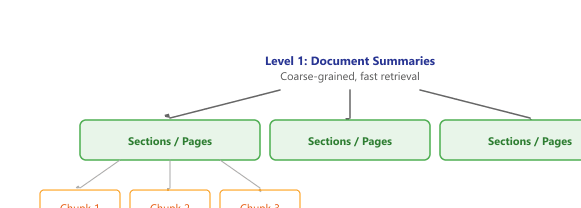
Hierarchical indexing creates multiple levels of abstraction. At the top level, document summaries are indexed. When a query matches a summary, the system then searches within that document's chunks for specific passages. This two-stage approach dramatically reduces the search space while maintaining recall. Figure 32.2.3 illustrates how hierarchical indexing narrows the search space.
32.2.1.2 Metadata Filtering
Adding metadata to chunks enables pre-retrieval filtering that narrows the search space before vector similarity is computed. Common metadata fields include document type, creation date, author, department, language, and topic tags. This filtering can be combined with vector search for efficient hybrid retrieval.
32.2.1.3 RAPTOR: Recursive Cluster-and-Summarize Trees
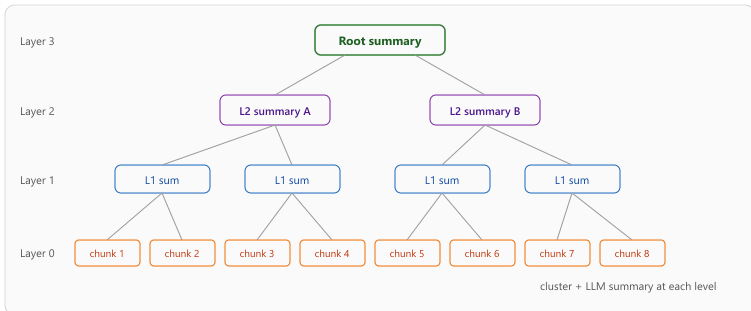
Naive hierarchical indexing assumes the corpus already exposes a clean document outline (book chapter, then section, then paragraph). Many real corpora do not. A pile of support tickets, a dump of research papers, or a podcast transcript archive has no built-in hierarchy at all. RAPTOR (Recursive Abstractive Processing for Tree-Organized Retrieval, Sarthi et al., ICLR 2024) builds the hierarchy automatically by recursively clustering and summarizing the chunks themselves.
The construction algorithm is a tight three-step loop. First, embed every leaf chunk with a sentence-embedding model. Second, cluster those embeddings (RAPTOR uses soft Gaussian mixture clustering over UMAP-reduced embeddings, so a chunk can belong to multiple parent topics). Third, for each cluster, call an LLM to write a short summary of the chunks inside, then treat that summary as a new node and re-embed it. Repeat: cluster the summary embeddings, summarize again, embed again, until the top of the tree contains only a handful of nodes that cover the entire corpus.
At retrieval time, RAPTOR offers two traversal modes. Tree traversal starts at the root, picks the top branches whose summary is most similar to the query, and descends layer by layer until reaching leaf chunks. Collapsed-tree retrieval ignores the hierarchy at query time and treats every node (leaf and summary) as a flat candidate pool, retrieving the top-$k$ by cosine similarity. The collapsed variant turns out to win in most benchmarks because it lets the retriever mix abstract summary nodes with concrete leaf chunks in a single context, which is exactly what multi-hop questions need. RAPTOR reports a 20% absolute improvement on the QuALITY long-document QA benchmark over the strongest flat-chunk baseline.
RAPTOR generalizes the LlamaIndex-style "summary of summaries" pattern into a principled algorithm: the corpus is now a tree of generated abstractions, not just the documents the author wrote. The cost is one extra LLM call per cluster at indexing time; the benefit is that questions like "what are the overarching themes across these 1,000 papers" become answerable without loading every paper into context.
Algorithm: BUILD-RAPTOR-TREE
Input:  leaf chunks C = {c_1, ..., c_n}, embedding model E,
        summarizer LLM S, max tree height H
Output: tree T with leaves C and summary nodes above

  layer_0 := [(c_i, E(c_i)) for c_i in C]
  for h = 1 .. H:
      clusters := SOFT-CLUSTER(layer_{h-1}, method = GMM-over-UMAP)
      layer_h  := []
      for cluster K in clusters:
          text_K   := concatenate text of nodes in K
          summary  := S("Summarize:", text_K)
          layer_h.append((summary, E(summary)))
      if |layer_h| <= 2: break    # stop at near-root
  Return T (all nodes across all layers)

Algorithm: SEARCH-RAPTOR-COLLAPSED
Input:  query q, tree T, top-k count k
Output: top-k context chunks (mix of leaves and summaries)

  pool   := all nodes in T (leaves and every summary level)
  scores := [cos(E(q), node.vec) for node in pool]
  Return TOP-K(pool, scores, k)

Algorithm: SEARCH-RAPTOR-TREE-TRAVERSAL
Input:  query q, tree T, branch width b, levels to descend L
Output: context nodes along the best root-to-leaf path

  frontier := root.children
  for l = 1 .. L:
      keep     := TOP-K(frontier, cos(E(q), .), b)
      frontier := union of (n.children for n in keep)
  Return keep ∪ (descended leaves)
Source: Sarthi et al., "RAPTOR: Recursive Abstractive Processing for Tree-Organized Retrieval," ICLR 2024 (arXiv:2401.18059). The official implementation defaults to collapsed-tree retrieval because empirically it wins on multi-hop benchmarks: mixing summary nodes with leaf chunks in one context lets the generator do both the high-level synthesis and the detail grounding in a single pass.
32.2.2 Evaluation and Common Failure Modes
Evaluating a RAG system requires measuring both retrieval quality and generation quality independently. The RAG triad framework assesses three dimensions: context relevance (did we retrieve the right documents?), groundedness (does the answer stick to the retrieved context?), and answer relevance (does the answer address the original question?).
32.2.2.1 Common Failure Modes
- Retrieval failure: The correct document exists in the knowledge base but is not retrieved, often because the query and document use different terminology.
- Context poisoning: Irrelevant or contradictory documents are retrieved, causing the LLM to generate incorrect answers grounded in bad context.
- Lost in the middle: The relevant document is retrieved but placed in the middle of the context where the LLM pays less attention to it.
- Abstention failure: The model generates a confident answer instead of admitting the context is insufficient to answer the question.
- Context overflow: Too many retrieved chunks exceed the token budget, causing truncation or performance degradation.
Before any LLM is even invoked, you can score the retriever as a pure information-retrieval (IR) system using the three classical ranking metrics. Each requires only a small labeled set of (query, gold_doc_ids) pairs (typically 100 to 500 examples). For a single query, let the retriever return a ranked list of $k$ candidates and let $\text{rel}_i \in \{0,1\}$ indicate whether the $i$-th candidate is in the gold set.
- Recall@k measures pure coverage at depth $k$: did the gold document make it into the top-$k$ at all? Formally, $\text{Recall@}k = \frac{|\,\text{gold} \cap \text{top-}k\,|}{|\,\text{gold}\,|}$. This is the upper bound on what the generator can possibly ground on; if recall@10 is 0.6, then 40% of queries will never see the right context no matter how clever the prompt. Typical production targets are recall@10 above 0.85.
- Mean Reciprocal Rank (MRR) rewards putting the first relevant document early in the list. $\text{MRR} = \tfrac{1}{|Q|} \sum_{q \in Q} \tfrac{1}{\text{rank}_q}$, where $\text{rank}_q$ is the position of the first relevant document for query $q$ (or $\infty$ if none, contributing 0). MRR is the right metric when downstream generation only needs one good chunk (single-hop QA); a score of 1.0 means the top result is always relevant, 0.5 means it is typically second.
- Normalized Discounted Cumulative Gain (nDCG@k) handles graded relevance (e.g. relevance scores 0/1/2/3 instead of binary) and discounts gains lower in the ranking with a log factor: $\text{DCG@}k = \sum_{i=1}^{k} \tfrac{2^{\text{rel}_i}-1}{\log_2(i+1)}$, then $\text{nDCG@}k = \text{DCG@}k\,/\,\text{IDCG@}k$ where IDCG is the DCG of the ideal ranking. nDCG is the workhorse metric in academic IR (TREC, BEIR benchmarks) because it credits both finding the gold documents and ranking them well.
The three metrics answer different questions: recall@k says "is the right answer reachable?", MRR says "is the top answer right?", and nDCG@k says "is the whole ranking good?". A production RAG diagnostic dashboard typically tracks all three at $k \in \{1, 5, 10, 20\}$, plus the RAG-triad generation-side scores below, because a failure in any of them points to a different bug (chunker, embedder, reranker, generator).
The RAG triad above is the intrinsic evaluation track: every metric scores the system against the retrieved context rather than against a gold answer, which means no labeled test set is required. The complementary extrinsic track scores generated answers against human-written reference answers using the classical NLG metrics covered in depth in Section 42.1. BLEU (Papineni et al., 2002) and ROUGE (Lin, 2004) compare n-gram overlap between candidate and reference and were originally designed for machine translation and summarization respectively; BERTScore (Zhang et al., 2020) replaces the n-gram match with cosine similarity over contextual embeddings and correlates better with human judgments for free-form answers. For RAG specifically, BLEU and ROUGE are too rigid (the same correct answer can be phrased many ways), so practitioners default to either BERTScore for surface-form similarity or LLM-as-judge correctness scores from RAGAS or ARES (Section 32.4.8.2) for semantic correctness. The intrinsic-vs-extrinsic split matters because they fail in different ways: an unfaithful answer scores high on BLEU if it happens to share n-grams with the reference, and a faithful answer scores low if it phrases the truth differently.
Tools like RAGAS (Retrieval Augmented Generation Assessment), TruLens, and DeepEval provide automated metrics for evaluating RAG pipelines. RAGAS computes faithfulness, answer relevance, and context precision scores using LLM-as-judge approaches. For production systems, a combination of automated metrics and human evaluation on a golden test set provides the most reliable quality signal.
The naive RAG pattern (chunk + embed + retrieve + generate) underpins many shipped products. Notion AI Q&A uses an internal RAG stack against the user's workspace pages with OpenAI embeddings and GPT-4. Glean, valued at $7.2B in 2025, runs enterprise RAG over Slack, Google Drive, and Confluence with a hybrid BM25-plus-dense retriever. GitHub Copilot Workspace's "ask the repo" feature is RAG over an indexed codebase. Mendable.ai (which powers the docs search on LangChain.com, Coinbase Pay, and Hugging Face) is a hosted RAG product. The stack is similar across all of these: an embedding model (OpenAI text-embedding-3-large or Voyage), a vector DB (Pinecone, Weaviate, or pgvector), and a generation step with a frontier model.
32.2.3 RAG vs. Long Context Windows
The rapid expansion of context windows raises a fundamental question: if a model can accept 1 million tokens or more in a single prompt, is RAG still necessary? Models like Gemini 1.5 Pro (1M tokens), Claude 3 (200K tokens), and GPT-4o (128K tokens) can process entire codebases, full books, or large document collections in a single request. Some practitioners have concluded that "just stuff everything in the context" eliminates the need for retrieval infrastructure. This conclusion, while tempting, overlooks several critical factors that keep RAG relevant even in an era of enormous context windows.
32.2.3.1 Why RAG Still Matters
Five distinct advantages keep RAG relevant even when the context window is large enough to hold your entire corpus. We walk through each in turn.
Cost and economics. Long-context inference is expensive. Processing 1M tokens through a frontier model costs orders of magnitude more than embedding a query and retrieving 5 relevant chunks. For a production system handling thousands of queries per hour against a 10M-token knowledge base, the cost difference between "retrieve then generate" and "load everything into context" can be 100x or greater. RAG allows you to pay embedding costs once at indexing time, then pay only for the retrieved subset at query time. For most enterprise workloads, this economic advantage is decisive.
Latency. Prefill time scales with context length. Processing 1M tokens takes seconds to tens of seconds even on high-end hardware, whereas a RAG system can retrieve relevant chunks and generate a response with a context of a few thousand tokens in under a second. For interactive applications where users expect sub-second responses, RAG provides a latency profile that long-context approaches cannot match. The time-to-first-token for a 1M token prompt is fundamentally constrained by the compute required to process the full attention matrix.
Freshness and dynamic knowledge. RAG systems can incorporate new information the moment it is indexed. When a document is updated, the RAG pipeline re-chunks and re-embeds it, making the new content immediately available to queries. Long-context approaches require re-loading the entire corpus for every request, and they cannot incorporate changes that occur between requests without rebuilding the full prompt. For knowledge bases that change hourly or daily (support tickets, news feeds, regulatory updates), RAG provides a natural mechanism for staying current.
Privacy and access control. RAG pipelines can enforce document-level access controls during retrieval. A user with clearance for Department A's documents sees only Department A's chunks in their context, even though the full knowledge base spans all departments. With a long-context approach, access control requires either maintaining separate prompts per user role or implementing complex filtering logic before context assembly. RAG's retrieval stage is a natural enforcement point for per-document permissions.
Accuracy at scale. Research on the "lost in the middle" problem (discussed in Section 4) shows that models struggle to attend equally to all parts of very long contexts. Information placed in the middle of a 100K+ token context is less likely to be used accurately than information placed at the beginning or end. RAG sidesteps this problem by placing only the most relevant chunks in context, ensuring they are in a position where the model attends to them reliably. Empirical studies have shown that for needle-in-a-haystack retrieval tasks, RAG with good retrieval outperforms naive long-context approaches once the corpus exceeds roughly 50K tokens.
32.2.3.2 When Long Context Wins
Long context does offer genuine advantages in specific scenarios. For tasks requiring holistic understanding of a single large document (such as summarizing an entire book, analyzing patterns across a full codebase, or answering questions that require synthesizing information scattered across many pages), long-context models can outperform RAG because they have access to the complete document and its structure. RAG's chunking process inevitably loses cross-chunk relationships and document-level structure. Additionally, for small, static knowledge bases (under 50K tokens), simply including the full content in context avoids the complexity of building and maintaining a retrieval pipeline.
32.2.3.3 Hybrid Approaches
The most effective production systems increasingly combine both approaches. A retrieve-then-read hybrid uses RAG to narrow a large corpus to the most relevant documents, then passes those complete documents (not just chunks) into a long-context model. This combines RAG's precision in finding relevant material with the long-context model's ability to reason across the full document structure. Another pattern uses RAG as a first pass, then applies a long-context model to re-rank and synthesize across the top retrieved results.
Google's Gemini team has documented a context caching approach that offers a middle ground. Frequently accessed documents are cached in the model's context at a reduced per-token rate, allowing repeated queries against the same corpus without re-processing the full context each time. This reduces the cost disadvantage of long-context approaches while preserving their holistic understanding advantage. However, caching is currently limited to a single session and does not solve the freshness or access control challenges.
32.2.3.4 Cache-Augmented Generation (CAG)
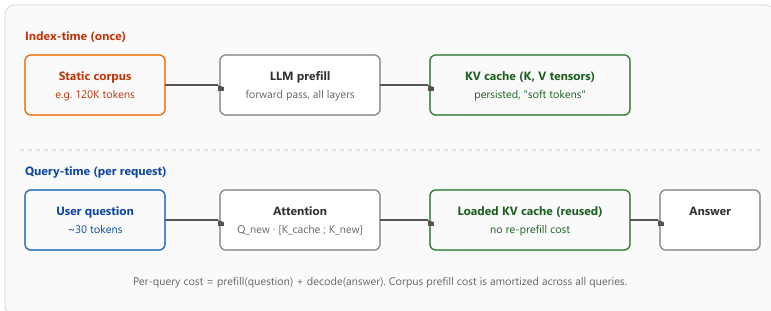
The academic name for the same middle-ground pattern is Cache-Augmented Generation (CAG). The recipe is: take the documents you would have retrieved, run them through the model once at indexing time, and persist the resulting KV cache to disk. At query time, the LLM loads that pre-computed cache, attends to it, and generates an answer without ever rerunning the (expensive) prefill over those documents. Conceptually, the documents have been baked into "soft tokens" that live in the attention key-value store rather than in the prompt.
CAG is a sensible production sweet spot for corpora that are small enough to fit in the context window of the chosen model (typically a few hundred thousand tokens), change rarely, and serve high query volume. Examples include the public API reference for a SaaS product, the engineering wiki for a single team, or a regulatory rulebook. The retrieval step disappears entirely (so no chunker, no embedder, no vector index to operate), latency drops because prefill is skipped, and you keep the LLM's holistic reasoning over the full corpus. The cost is that any document update invalidates the cache and forces a full re-prefill, so CAG is the wrong pattern for fast-moving knowledge bases (where RAG wins) or for multi-tenant access control (where per-user prompt slicing is harder than per-user retrieval filtering).
Gemini context caching, Anthropic prompt caching, and OpenAI's response-cache hints are the three production realizations of CAG you will meet most often. Each charges a discounted per-token rate (typically 10% to 25% of the input price) for cached tokens, which is exactly the economic mechanism that makes CAG viable. Think of CAG as the third corner of a triangle with RAG and naive long-context: RAG retrieves and prefills a small context per query, long-context prefills a large context per query, CAG prefills a large context once and reuses it for many queries.
The per-query cost difference between naive long-context and CAG is easy to write down. Let $C_{\text{prefill}}$ be the cost of running the corpus through the model and $C_{\text{generate}}$ the cost of a single long-context call (which includes corpus prefill plus question prefill plus decode). Then a CAG call avoids the corpus prefill on every cached hit:
$$ C_{\text{CAG}} \;=\; C_{\text{generate}} - C_{\text{prefill}} \;+\; \alpha \cdot C_{\text{prefill}}, $$
where $\alpha \in [0.10, 0.25]$ is the cached-token discount charged by the provider. For $N$ queries against the same corpus the amortized cost is $C_{\text{prefill}} + N \cdot (C_{\text{generate}} - C_{\text{prefill}} + \alpha C_{\text{prefill}})$, which converges to $\alpha C_{\text{prefill}} + (C_{\text{generate}} - C_{\text{prefill}})$ per query as $N$ grows large, an order of magnitude cheaper than the naive $N \cdot C_{\text{generate}}$ baseline.
In practice the cache is exposed as a server-side handle that the client passes back on every request. The following snippet shows the Anthropic API form, where a single cache_control marker on the corpus message turns one prompt into an indexing call and every subsequent prompt into a cached-prefix lookup:
import anthropic

client = anthropic.Anthropic()
CORPUS = open("api_reference.md").read()  # 120K tokens, changes weekly

def ask(question: str) -> str:
    response = client.messages.create(
        model="claude-opus-4-5",
        max_tokens=512,
        system=[
            {
                "type": "text",
                "text": "You answer questions strictly from the provided reference.",
            },
            {
                "type": "text",
                "text": CORPUS,
                # First call: pay full input price, server stores KV cache for ~5 min.
                # Later calls within the TTL: cached read at ~10% of input price.
                "cache_control": {"type": "ephemeral"},
            },
        ],
        messages=[{"role": "user", "content": question}],
    )
    usage = response.usage
    print(f"cache_creation={usage.cache_creation_input_tokens}, "
          f"cache_read={usage.cache_read_input_tokens}")
    return response.content[0].text

print(ask("What is the rate limit for POST /v1/messages?"))  # warm path
print(ask("How do I list models?")) # cached pathcache_control marker on the corpus message instructs the server to persist the KV cache for that prefix. The usage.cache_read_input_tokens field confirms that subsequent calls reuse it: corpus prefill cost is paid once, then amortized across every question in the cache window. Gemini context caching and OpenAI prompt caching expose the same pattern with slightly different SDK calls.If your corpus is under 200K tokens, updated weekly, and serves more than ten queries per minute, prototype the CAG variant before the RAG variant. The infrastructure savings (no vector DB, no chunking, no embedding service) often outweigh the slightly higher per-query token cost, and you avoid an entire category of retrieval-failure bugs.
RAG and long context are complementary, not competing, paradigms. RAG excels at efficient, cost-effective retrieval from massive, dynamic knowledge bases with access controls. Long context excels at holistic reasoning over moderate-sized document sets. The best production systems use RAG to select relevant material and long context to reason deeply over it. As context windows continue to grow and costs decline, the boundary between these approaches will shift, but the fundamental advantages of retrieval (cost, latency, freshness, privacy) ensure RAG remains a core architectural pattern.
| Dimension | RAG | Long Context | CAG | Hybrid |
|---|---|---|---|---|
| Cost per query | Low (small context) | High (full corpus) | Low (cached prefill) | Medium |
| Latency | Fast (sub-second) | Slow (seconds) | Fast (prefill skipped) | Moderate |
| Freshness | Real-time updates | Static per request | Cache invalidation on edit | Real-time |
| Access control | Natural enforcement | Complex to implement | Hard (one cache per tenant) | Natural enforcement |
| Holistic reasoning | Limited by chunking | Strong | Strong | Strong |
| Corpus scale | Unlimited | Limited by window | Limited by window | Unlimited |
Objective
Build a complete Retrieval-Augmented Generation pipeline: ingest documents, embed and index them, retrieve relevant passages for a query, and generate a grounded answer with source citations.
What You'll Practice
- Document ingestion and chunking for a RAG knowledge base
- Building a vector index with sentence-transformers
- Implementing retrieval with cosine similarity search
- Crafting RAG prompts that ground the LLM in retrieved context
- Adding source citations to generated answers
Setup
The following cell installs the required packages and configures the environment for this lab.
You will need an OpenAI API key (or any OpenAI-compatible endpoint).
Steps
Step 1: Create the knowledge base
Define a set of documents simulating an internal company wiki.
knowledge_base = [
    {"id": "doc1", "title": "Vacation Policy",
    "text": "All full-time employees receive 20 days of paid vacation per year. Vacation days accrue monthly at 1.67 days per month. Unused days carry over up to 10 days maximum. Requests for 3+ consecutive days need 2 weeks advance notice."},
    {"id": "doc2", "title": "Remote Work Policy",
    "text": "Employees may work remotely up to 3 days per week with manager approval. Core hours are 10 AM to 3 PM local time. A stable internet connection and dedicated workspace are required. International remote work requires HR and Legal approval."},
    {"id": "doc3", "title": "Health Benefits",
    "text": "Three health plans available: Basic (80% coverage, $1500 deductible), Standard (90%, $750), Premium (95%, $250). Dental and vision included in Standard and Premium. Open enrollment occurs annually in November."},
    {"id": "doc4", "title": "Expense Reimbursement",
    "text": "Submit expenses within 30 days. Receipts required over $25. Meals reimbursed up to $75/day during travel. Domestic flights: economy class. International flights over 6 hours: business class. Hotels up to $200/night."},
    {"id": "doc5", "title": "Performance Reviews",
    "text": "Reviews conducted in June and December. Self-assessment required before each review. Manager rating on 1 to 5 scale. Rating 4+ qualifies for bonus. Two consecutive ratings below 2 triggers a performance improvement plan."},
    ]
print(f"Knowledge base: {len(knowledge_base)} documents")
for doc in knowledge_base:
print(f" [{doc['id']}] {doc['title']} ({len(doc['text'])} chars)")Hint
In production, these documents would come from files, databases, or web scraping, and each would be chunked into smaller pieces. For this lab, each document is already a reasonable chunk size.
Step 2: Build the vector index
Encode all documents into embeddings for similarity search.
from sentence_transformers import SentenceTransformer
import numpy as np
embed_model = SentenceTransformer("all-MiniLM-L6-v2")
doc_texts = [doc['text'] for doc in knowledge_base]
doc_embeddings = embed_model.encode(doc_texts)
doc_norms = np.linalg.norm(doc_embeddings, axis=1)
print(f"Index built: {doc_embeddings.shape}")Hint
Pre-computing doc_norms avoids recomputing them on every query, making search faster.
Step 3: Implement retrieval
Build a function that finds the most relevant documents for a query.
import numpy as np
def retrieve(query, top_k=2):
    """Retrieve top-k documents by cosine similarity."""
    q_emb = embed_model.encode(query)
    scores = np.dot(doc_embeddings, q_emb) / (doc_norms * np.linalg.norm(q_emb))
    top_idx = np.argsort(scores)[::-1][:top_k]
    return [(knowledge_base[i], scores[i]) for i in top_idx]
# Test against four representative queries from the lab's policy KB.
for query in ["How many vacation days do I get?", "Can I work from home?",
    "What health insurance options exist?", "How do I submit expenses?"]:
    results = retrieve(query, top_k=2)
    print(f"\nQ: {query}")
    for doc, score in results:
        print(f" [{score:.3f}] {doc['title']}")
retrieve helper that runs cosine similarity over the indexed policy chunks and returns the top-k matches. The printed scores show how cleanly the right policy dominates for each well-formed query.Hint
Retrieval should return the vacation policy for vacation questions, remote work policy for WFH questions, and so on. If results look wrong, check that embeddings were computed correctly.
Step 4: Build the RAG generation pipeline
Combine retrieval with LLM generation, grounding answers in retrieved context.
from openai import OpenAI
client = OpenAI()
def rag_answer(query, top_k=2):
    """Retrieve context and generate a grounded answer."""
    retrieved = retrieve(query, top_k)
    # Build context with source labels
    context = "\n\n".join(
        f"[Source {i+1}: {doc['title']}]\n{doc['text']}"
        for i, (doc, _) in enumerate(retrieved))
    system = ("You are a helpful HR assistant. Answer ONLY from the provided "
        "context. Cite sources with [Source N]. If the context does not "
        "cover the question, say so clearly.")
    user_msg = f"Context:\n{context}\n\nQuestion: {query}\n\nAnswer:"
    response = client.chat.completions.create(
        model="gpt-4o-mini",
        messages=[{"role": "system", "content": system},
        {"role": "user", "content": user_msg}],
        temperature=0.3, max_tokens=300)
    answer = response.choices[0].message.content
    sources = [doc['title'] for doc, _ in retrieved]
    return answer, sources
# Test the full pipeline
for q in ["How many vacation days do I get?", "Can I work from home?",
    "What health plans are available?", "How do I expense meals?"]:
    answer, sources = rag_answer(q)
print(f"\nQ: {q}\nA: {answer}\nSources: {sources}\n{'='*50}")rag_answer stitches retrieved chunks into a citation-tagged context, instructs gpt-4o-mini to answer "ONLY from the provided context", and returns both the grounded answer and the source titles for attribution.Hint
The system prompt is critical: instruct the model to answer ONLY from context, cite sources, and admit uncertainty. Temperature 0.3 reduces hallucination risk.
Step 5: Test with out-of-scope queries
Verify the system handles unanswerable questions gracefully.
out_of_scope = [
    "What is the company's stock price?",
    "Who is the CEO?",
    "What programming languages does engineering use?",
    ]
print("=== Out-of-Scope Query Test ===")
for q in out_of_scope:
    answer, sources = rag_answer(q)
print(f"\nQ: {q}\nA: {answer}")Hint
A well-prompted RAG system should say "I don't have enough information" rather than hallucinating. If the model invents answers, strengthen the system prompt.
Expected Output
- Retrieval returning the correct document for each in-scope query
- Generated answers citing sources and referencing facts from retrieved documents
- Out-of-scope queries receiving "I don't have enough information" responses
Stretch Goals
- Add a cross-encoder reranking step between retrieval and generation
- Implement query expansion: generate alternative phrasings before searching
- Add a confidence score based on retrieval similarity scores
Complete Solution
from sentence_transformers import SentenceTransformer
from openai import OpenAI
import numpy as np
client = OpenAI()
embed_model = SentenceTransformer("all-MiniLM-L6-v2")
kb = [
    {"id":"doc1","title":"Vacation Policy","text":"20 days PTO per year. Accrue 1.67/month. Carry over max 10 days. 2 weeks notice for 3+ days."},
    {"id":"doc2","title":"Remote Work","text":"Up to 3 days/week remote with manager approval. Core hours 10AM-3PM. International needs HR/Legal."},
    {"id":"doc3","title":"Health Benefits","text":"Basic (80%/$1500), Standard (90%/$750), Premium (95%/$250). Dental/vision in Standard+. November enrollment."},
    {"id":"doc4","title":"Expenses","text":"Submit within 30 days. Receipts over $25. Meals $75/day. Domestic economy, international biz class 6hr+. Hotels $200/night."},
    {"id":"doc5","title":"Reviews","text":"June and December. Self-assessment required. 1-5 scale. 4+ for bonus. Two sub-2 ratings triggers PIP."},
    ]
texts = [d['text'] for d in kb]
embs = embed_model.encode(texts)
norms = np.linalg.norm(embs, axis=1)
def retrieve(q, k=2):
    qe = embed_model.encode(q)
    scores = np.dot(embs, qe) / (norms * np.linalg.norm(qe))
    idx = np.argsort(scores)[::-1][:k]
    return [(kb[i], scores[i]) for i in idx]
def rag(q, k=2):
    ret = retrieve(q, k)
    ctx = "\n\n".join(f"[Source {i+1}: {d['title']}]\n{d['text']}" for i,(d,_) in enumerate(ret))
    r = client.chat.completions.create(model="gpt-4o-mini",
        messages=[{"role":"system","content":"Answer ONLY from context. Cite [Source N]. Say if info insufficient."},
        {"role":"user","content":f"Context:\n{ctx}\n\nQ: {q}\nA:"}],
        temperature=0.3, max_tokens=300)
    return r.choices[0].message.content, [d['title'] for d,_ in ret]
for q in ["How many vacation days?","Can I work remotely?","Health plan options?","Who is the CEO?"]:
    a, s = rag(q)
print(f"Q: {q}\nA: {a}\nSources: {s}\n{'='*50}")Split documents at paragraph or section boundaries rather than fixed token counts. A 512-token chunk that splits a sentence in half creates two useless fragments. Use heading detection or sentence boundaries as natural split points.
- RAG = Retrieve + Augment + Generate: The pattern retrieves relevant documents, injects them into the prompt, and generates grounded responses. This addresses LLM knowledge cutoffs, incompleteness, and unverifiability.
- Ingestion quality determines retrieval quality: The chunking strategy, chunk size, overlap, metadata preservation, and embedding model choice all critically affect downstream retrieval performance.
- Context window management matters: The lost-in-the-middle effect means that simply adding more documents can hurt performance. Limit to 3 to 5 high-quality chunks and place the most relevant ones first.
- RAG and fine-tuning are complementary: Use fine-tuning to teach the model how to use context effectively; use RAG to supply the knowledge. The combination outperforms either alone.
- Evaluate both retrieval and generation: The RAG triad (context relevance, groundedness, answer relevance) provides a comprehensive framework for diagnosing failures at each pipeline stage.
Who: A DevOps engineer and an ML engineer at a 500-person software company
Situation: Engineers spent an average of 45 minutes per day searching across Confluence, Notion, and Slack for answers to internal process questions (deployment procedures, on-call runbooks, architecture decisions).
Problem: A vanilla LLM chatbot hallucinated confidently about internal procedures it had never seen. Simply stuffing documents into the prompt exceeded the context window and cost $0.12 per query.
Dilemma: Fine-tuning the model on internal docs would bake in stale information (procedures changed weekly). Pure keyword search missed semantic matches (e.g., "how to roll back a deploy" vs. "revert production release").
Decision: They built a naive RAG pipeline: embed all documentation into a vector store, retrieve the top 5 chunks per query, and pass them as context to GPT-4 with explicit grounding instructions.
How: Documents were chunked at 400 tokens with 50-token overlap, embedded with text-embedding-3-small, and stored in Qdrant. The system prompt instructed the model to cite chunk sources and say "I don't know" when context was insufficient.
Result: Engineers reported 70% fewer failed searches. Average query cost dropped to $0.008. The grounding instruction reduced hallucinations from 34% to 4% on a 200-question evaluation set.
Lesson: A well-constructed naive RAG pipeline with clear grounding instructions solves the majority of internal knowledge retrieval problems before you need any advanced techniques.
Show Answer
Show Answer
Show Answer
Show Answer
Show Answer
Self-RAG (Asai et al., 2024) trains the LLM to decide when to retrieve, what to retrieve, and how to use retrieved passages, eliminating the need for a separate retrieval orchestrator. Corrective RAG (CRAG) adds a lightweight evaluator that assesses retrieved document relevance and triggers web search as a fallback when the initial retrieval is insufficient. Speculative RAG parallels speculative decoding by generating a draft response without retrieval and then verifying claims against retrieved evidence.
Research into long-context models vs. RAG is exploring whether models with 1M+ token windows can replace RAG entirely for certain use cases, though evidence suggests RAG still outperforms long-context stuffing for precision-critical applications.
Exercises
An LLM confidently answers a question about a company's Q3 2024 earnings, but the information is wrong. How does RAG prevent this failure mode? What failure modes does RAG introduce instead?
Show Answer
RAG grounds the LLM in retrieved documents, reducing hallucination. It introduces new failure modes: (a) relevant document not retrieved (retrieval failure), (b) correct document retrieved but LLM ignores it (attention failure), (c) outdated or incorrect documents in the knowledge base (data quality failure).
Name the four stages of a naive RAG pipeline and describe what happens at each stage.
Show Answer
(1) Query encoding: convert user query to an embedding vector. (2) Retrieval: find the most similar document chunks from the vector store. (3) Augmentation: combine retrieved chunks with the query in a prompt template. (4) Generation: pass the augmented prompt to the LLM for answer generation.
A legal firm wants their LLM to answer questions about their proprietary case database. Should they use RAG or fine-tuning? What if the database changes weekly?
Show Answer
RAG is the clear choice. It handles weekly updates by re-indexing new documents without retraining. Fine-tuning would require retraining every week, is expensive, and risks catastrophic forgetting. RAG also provides citations to specific cases.
You retrieve 10 relevant chunks, but they total 8000 tokens and your prompt template plus instructions use 2000 tokens. Your model has a 4096-token context window. What strategies can you use?
Show Answer
Options: (a) reduce to top-K chunks by relevance score, (b) summarize retrieved chunks before inserting, (c) use a model with a larger context window, (d) implement a reranker to select only the most relevant chunks, (e) truncate lower-ranked chunks.
Models now support 128K+ context windows. Does this make RAG obsolete? Argue both sides and state your conclusion.
Show Answer
Against RAG: long context could ingest entire knowledge bases, eliminating retrieval errors. For RAG: long context is expensive (cost scales linearly), attention degrades over long sequences ("lost in the middle"), and dynamic knowledge bases still need a retrieval mechanism. Conclusion: RAG remains necessary for large-scale, dynamic, cost-sensitive applications, while long context helps with small, static corpora.
Build a minimal RAG pipeline: load a 10-page PDF, chunk it, embed with sentence-transformers, store in ChromaDB, and answer 5 questions. Compare answers with and without retrieval.
Using the same retrieval results, experiment with three prompt templates: (a) "Answer based on the context: {context}", (b) a structured template with numbered sources, (c) a template that instructs the model to cite sources. Compare answer quality and citation accuracy.
Deliberately create five queries that expose RAG failure modes: irrelevant retrieval, partial retrieval, conflicting sources, insufficient context, and hallucination despite context. Document each failure and propose a mitigation strategy.
Implement a two-level index: document summaries as the first level, section chunks as the second level. Compare retrieval precision against a flat single-level index on the same corpus.
What's Next?
In the next section, Section 32.3: Vector Stores and Embedding Models in RAG, we go a layer deeper into the retrieval stack: how vector stores actually index embeddings, which embedding models you should pick for which corpus, and how their interaction sets the ceiling on RAG quality.